History
Divriği's main monuments date from the rule of a branch of the Mengücek family, which TDV places between 1180 and 12771,3. TDV names Süleyman, a grandson of Mengücek Gazi, as the first lord of this branch; his son Seyfeddin Şehinşah built the citadel mosque of Divriği in 576 AH (1180-1181)1. Şehinşah's tomb stands in the centre of the town, and its inscription is dated 592 AH (1196)1,2. Coins and the inscription's wording show that he was still alive after 593 AH (1197), so the tomb was ready in his lifetime1. His wife was later buried here as well, and the people of Divriği came to call it Sitti Melik, or Melike, after her1,2,3.
Phrases in the inscription, such as “slayer of the unbelievers and the polytheists”, suggest that Şehinşah took part in holy-war campaigns (gaza)1. It also calls him the friend of the poor and the wretched and the father of orphans and the oppressed, and it gives him the Turkish titles alp, kutluğ, uluğ, tuğrul, tigin and cebûye (yabgu), which all Turkish sultans and emirs of the time used1. Another important feature, TDV notes, is the genealogy: it names Mengücek Gazi as the father of İshak and gives him the epithets gazi and martyr1. Şehinşah's grandson Ahmed Şah later built the Great Mosque of Divriği1.
Architecture
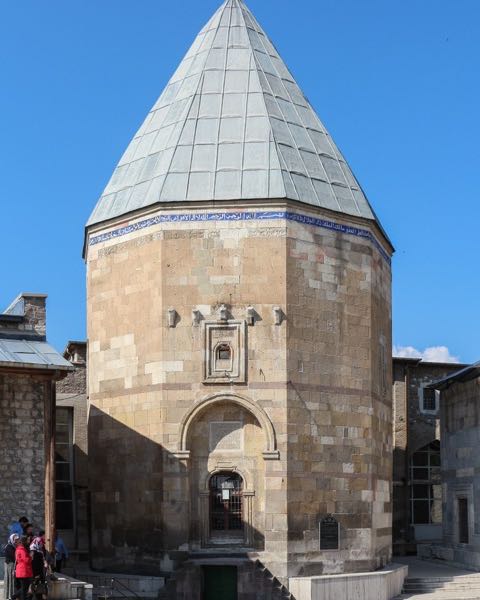
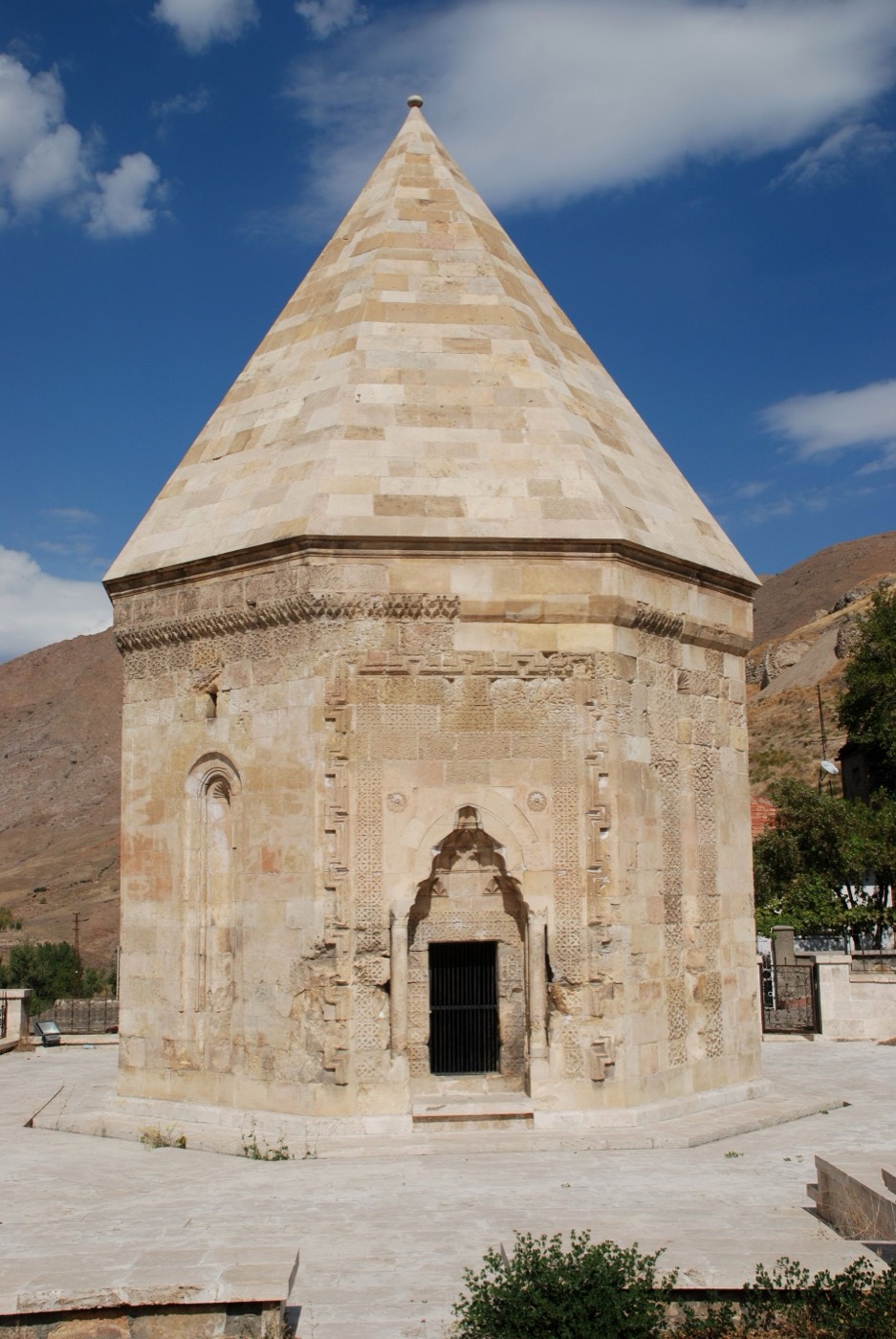
The tomb is a single-storey octagon on an octagonal base, with no crypt; a dome covers the room inside and an eight-sided pyramidal cap covers it outside2,5. It is built of finely cut yellowish stone4,5. Oluş Arık counts it, with the tomb of Halifet Gazi in Amasya, among the first Anatolian tombs with an octagonal body and an octagonal pyramidal cap, and names the two as the most noteworthy examples of walls faced on both sides with cut stone over a rubble core6. The Courtauld's survey of Divriği calls it the most elaborate of a group of plain octagonal tombs in the town, and a model for the others in plan, material and stonework4.
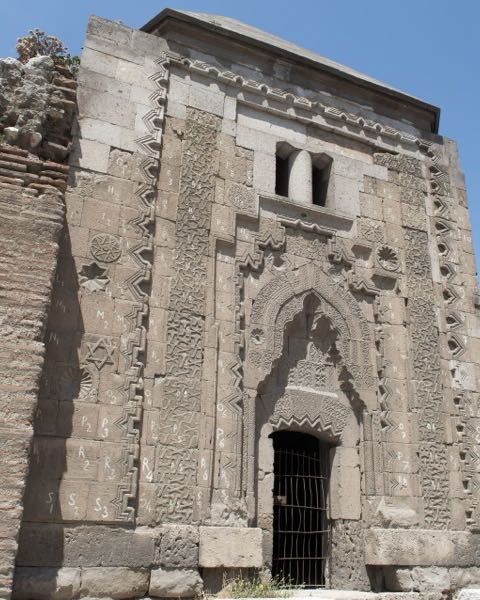
The entrance is on the south5. Two engaged columns flank the door, which sits under a five-tier muqarnas hood within a pointed arch4,5. Rosettes with twelve lobes fill the spandrels, and two lines of carved inscription run above the door4,5. Two bands of low-relief geometric ornament, built up from interlaced octagons around stars, frame the whole portal, and TDV notes that these rich interlaces continue a traditional ornament2,4,5. Each of the two faces beside the portal has a niche with a fan-shaped hood, which Şahin relates to local Christian architecture, and a band of religious inscription runs round the building under the cap, above two rows of muqarnas4,5. High on the south-east face a builder's signature has been read as the work of Tut Bey, son of Behram, of Maragha, but Önkal doubted this reading and Bayburtluoğlu proposed the name al-Malati5.
Inside
The tomb has a single room and no burial floor below: Şahin notes that the Divriği tombs lack the burial floor found, for example, in the tomb of Mengücek Gazi at Kemah5. The octagonal room is covered by a dome, which the pyramidal cap hides from outside2,5. Şehinşah and, later, his wife are buried here1,3.
What to look for
- The south portal: a five-tier muqarnas hood between engaged columns, framed by bands of interlaced octagons4,5.
- Twelve-lobed rosettes in the spandrels and two lines of inscription over the door4,5.
- Fan-hooded niches on the two faces beside the portal4,5.
- The builder's signature high on the south-east face, whose reading is still debated5.
Visiting
- The tomb stands in the centre of Divriği, in the Şemsibezirgan quarter between the citadel and the lower town1,4,8.
- Other tombs of the Mengücek period in the town include that of the treasurer Kamereddin, also dated 592 AH (1196), and the Kemankeş tomb of the chamberlain Nureddin Salih, of 638 AH (1240-1241)2,3.
- The Great Mosque and Hospital of Divriği, founded by Emir Ahmed Şah in 1228-1229, is in the same town and has been a UNESCO World Heritage property since 19857.
Official information: General Directorate of Foundations (Vakıflar Genel Müdürlüğü), named as responsible for the building in the inventory of the Sivas Provincial Directorate of Culture and Tourism on Kültür PortalıDirectionsOpen in OpenStreetMapGuided tours in Divriği