History
The tomb belongs to the complex named after Mahperi Hatun, a wife of Sultan Alaeddin Keykubad I and mother of Keyhüsrev II, opposite the citadel of Kayseri: a mosque, a madrasa, her tomb and a double bath1,3,6. Only the mosque is dated: inscriptions over both its portals give 635 AH (1237-1238), early in her son's reign2,3. Mahperi was probably born a Christian; Blessing suggests that the mosque may have been her first foundation as a Muslim, and Doğan also links it with her conversion2,3,4. After the Mongol victory at Kösedağ in 1243 she was led into Mongol captivity, yet Ibn Bibi records her alive in 1254; the date of her death is unknown2.
The tomb carries no date, and its place in the building sequence is debated2,3. Albert Gabriel and later Mahmut Akok saw it as an addition to the mosque and madrasa, while Haluk Karamağaralı argued that it took the place of an earlier building, perhaps a baptistery, and dated it to the 1260s or 1270s2,3. Blessing places the burial, and presumably the building, between 1254, when Mahperi is last recorded alive, and 1284, when her granddaughter was buried here2. Nermin Şaman Doğan thinks Mahperi may have had it built in her lifetime, and argues that the complex should bear the name Mahperi, used in its inscriptions, rather than Huand4.
Architecture
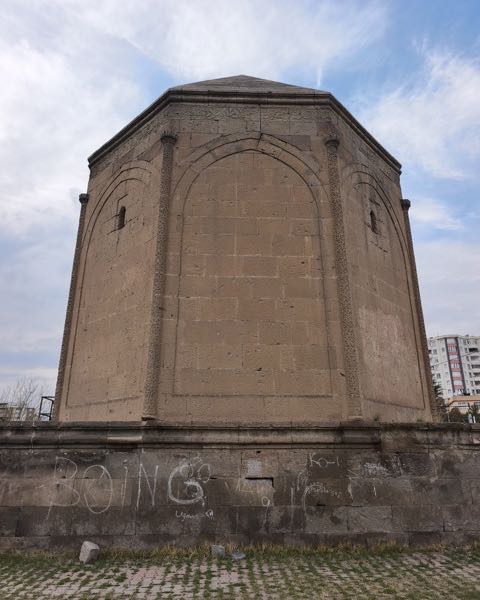
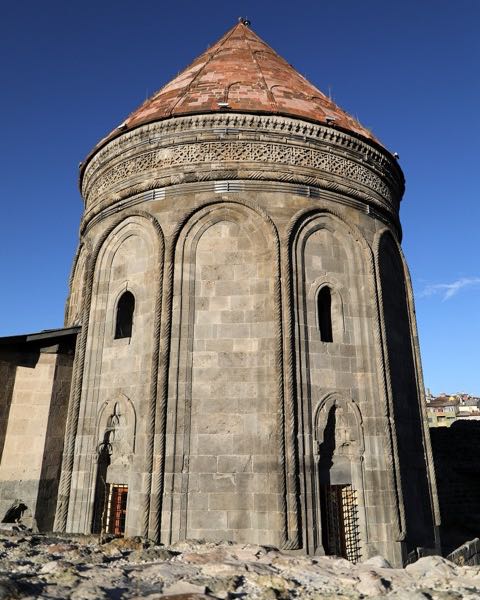
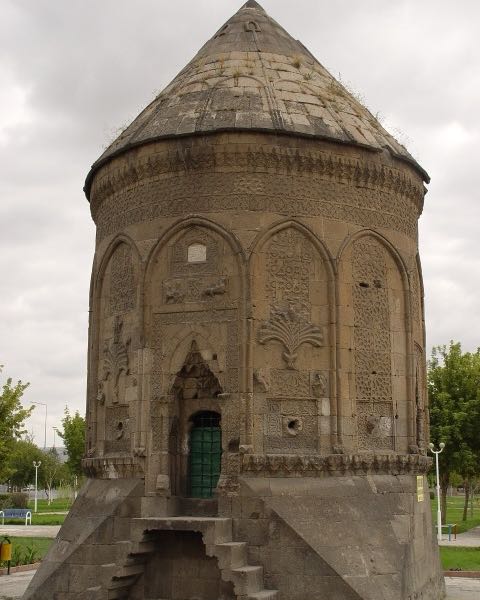
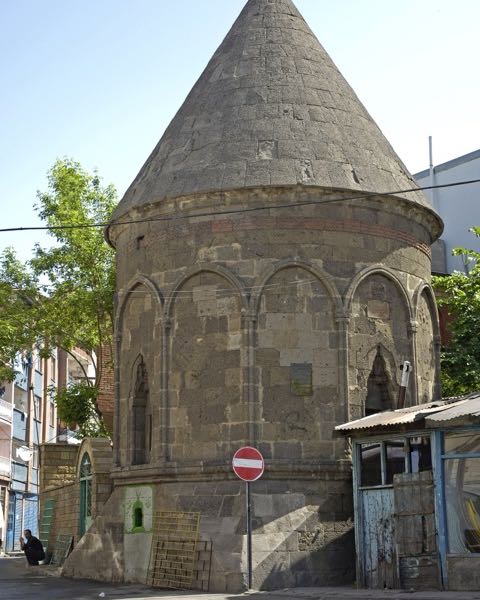
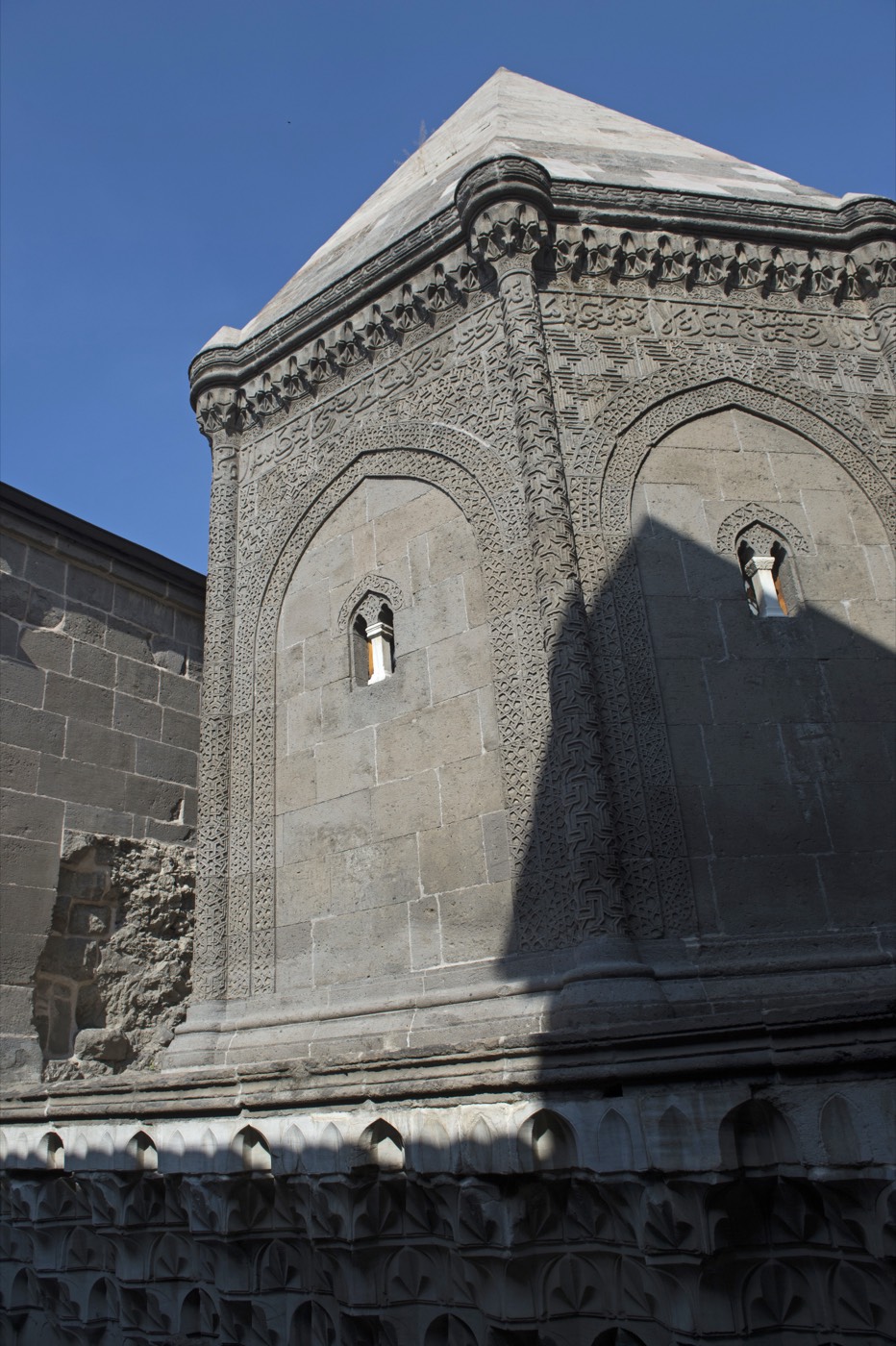
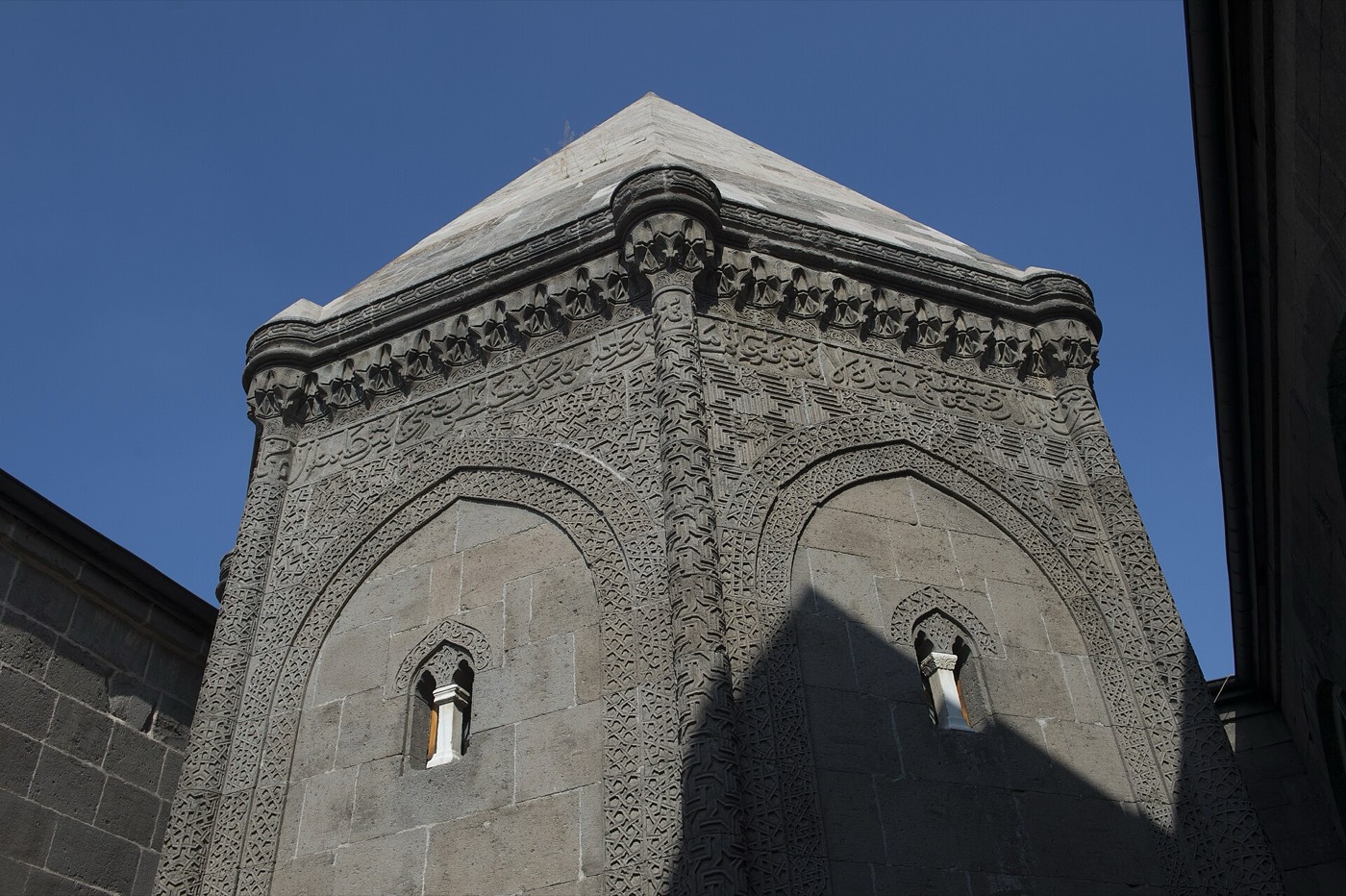
The tomb is an octagonal tower under an eight-sided pyramidal roof, standing in a small courtyard between the north-west corner of the mosque and the madrasa, with one of its eight sides fused into the madrasa wall1,2,4. Its body is built of the same dark grey stone as the mosque and madrasa, but its square base consists of rows of muqarnas cells carved in white marble, five rows according to Doğan2,3,4. Round mouldings run up the corners, geometric bands form blind arches on each face, and small two-light windows with marble colonnettes are framed by carved scrolls whose motifs differ from face to face2. Below the muqarnas cornice under the roof runs the Throne Verse (Qur'an 2:255) in thuluth2,4.
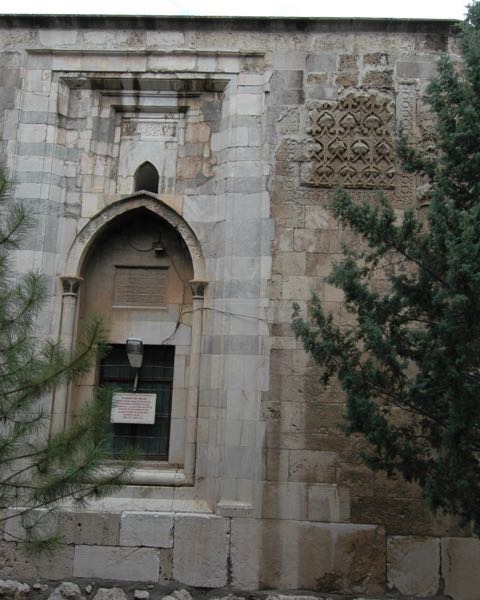
From the street the tomb is almost hidden: on the west front, between the portals of the mosque and the madrasa, only its roof shows above a wall pierced by four narrow slits2. Blessing suggests that these slits invited passers-by to look at the founder's tomb and say a prayer for her2. A visitor entering the mosque by its west portal glimpses the tomb through partly open arches beside the entrance corridor but cannot reach it from there2,3. Doğan reads this placement as a deliberate effort to make the tomb seen before the mosque itself4.
Inside
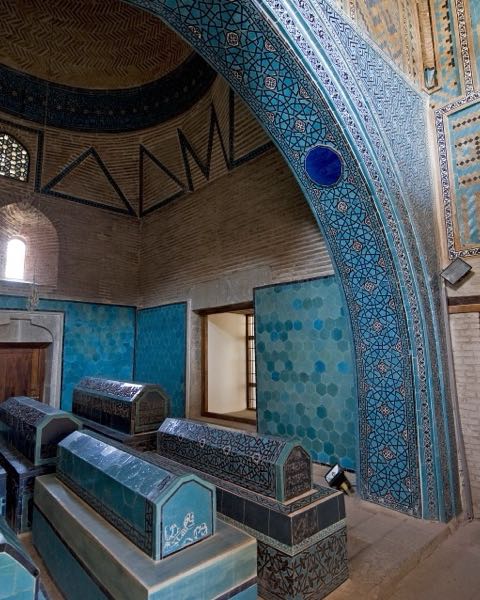
The upper chamber is entered from a side room of the madrasa1,2,4. Three stone cenotaphs stand inside and mark burials in the closed crypt below2,3. Mahperi Hatun's, made from an old sarcophagus lid, carries an inscription that praises her as the Mary of her Age and the Khadija of her Time and names her as mother of the late sultan Keyhüsrev, son of Keykubad1,2. The second belongs to her granddaughter Selçuk Hatun, daughter of Keyhüsrev II, and is dated Muharram 683 AH (1284); the third, plastered and without inscription, is unidentified1,2. Apart from these inscriptions, the only decoration is a five-sided mihrab with a muqarnas hood in the qibla wall2,4.
What to look for
- The base of white marble muqarnas under the dark stone body2,3.
- The Throne Verse band below the roof cornice2,4.
- Two-light windows with marble colonnettes and carved scrolls that change from face to face2.
- The view of the tomb through the arches by the mosque's west entrance2,3.
- Mahperi Hatun's cenotaph, whose inscription names her mother of Keyhüsrev II1,2.
Visiting
- The tomb is entered through the madrasa, and the municipality notes that Mahperi Hatun's cenotaph can be visited5.
- The complex stands in the centre of Kayseri, facing the medieval citadel3.
- From the mosque's west entrance the tomb can be seen through the arches of the entrance corridor2,3.
Official information: Kayseri Metropolitan Municipality (visitor information)DirectionsOpen in OpenStreetMapGuided tours in Kayseri