History
Osman Gazi (Osman I), founder of the Ottoman state, died in 1324 according to TDV and Kültür Portalı, by tradition while his son Orhan was besieging Bursa; the nomination file gives 13262,6,8. Bursa surrendered to Orhan on 6 April 13267. TDV records the tradition that Osman, watching the city during the long siege, saw a monastery chapel shining like silver and asked to be buried under its dome4. After the conquest Orhan moved his father's remains from Söğüt to this round chapel, known as the Gümüşlü Kümbet (silver dome), part of a monastery inside the citadel that the nomination file identifies as Saint Elias's2,4,8. Other parts of the monastery became Orhan's madrasa and a mosque4.
Orhan died of plague in Bursa in March 1362 and was buried near his father, probably in the part of the monastery that had become a mosque5,7. The nomination file cites a restitution drawing by Albert Gabriel and a late 18th-century painting that show the graves of both rulers in a single building2. Osman's round building burned in 1801 and was repaired; the earthquake of 1855 damaged it badly and destroyed Orhan's tomb4,5. Sultan Abdülaziz had both rebuilt in the style of his own day, Osman's a little larger than before, and the chronogram of its inscription gives 1280 AH (1863)4,8. In 2014 both tombs became part of the Bursa and Cumalıkızık World Heritage property1,3.
Architecture
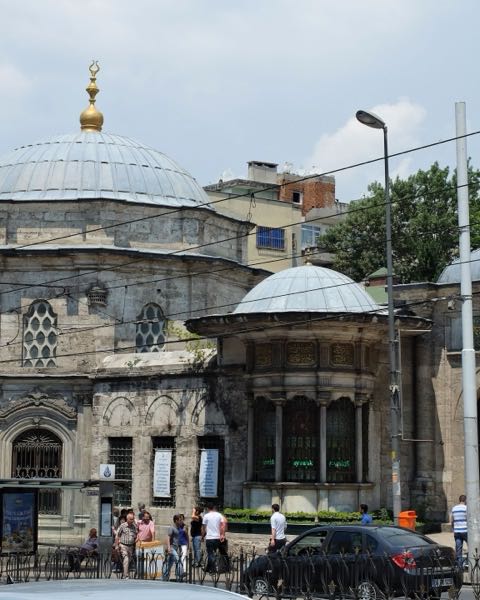
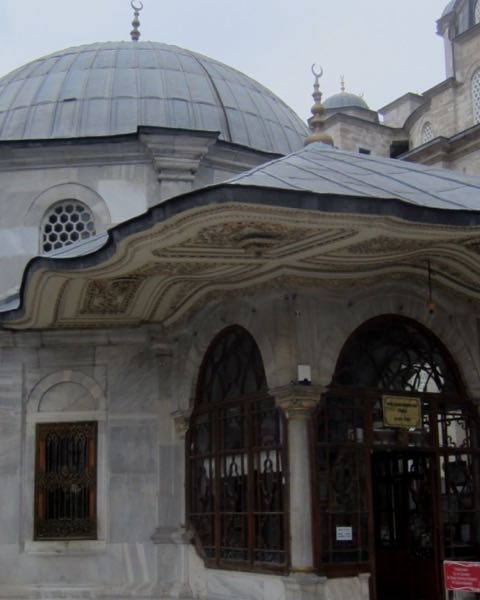
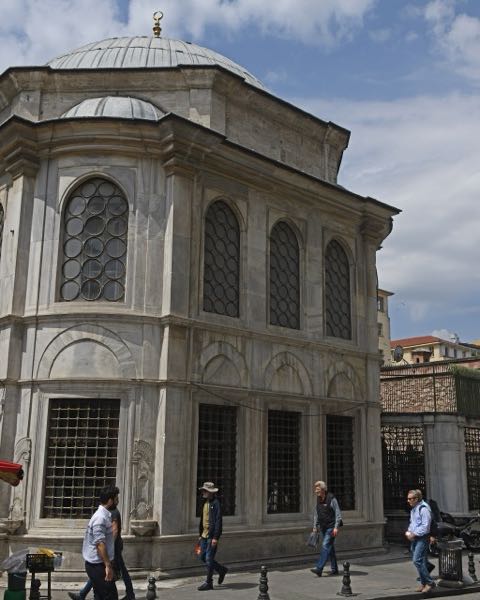
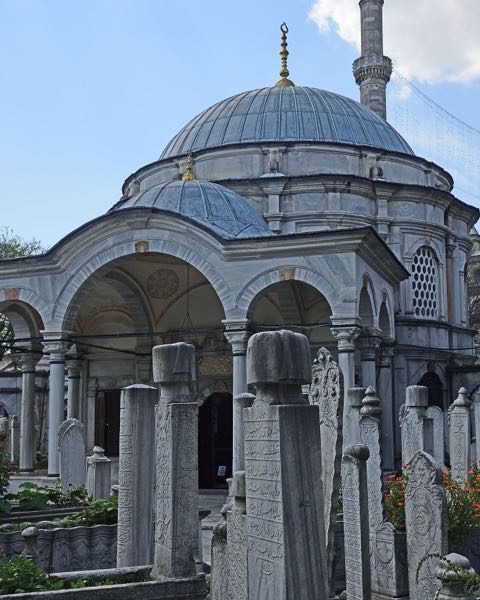
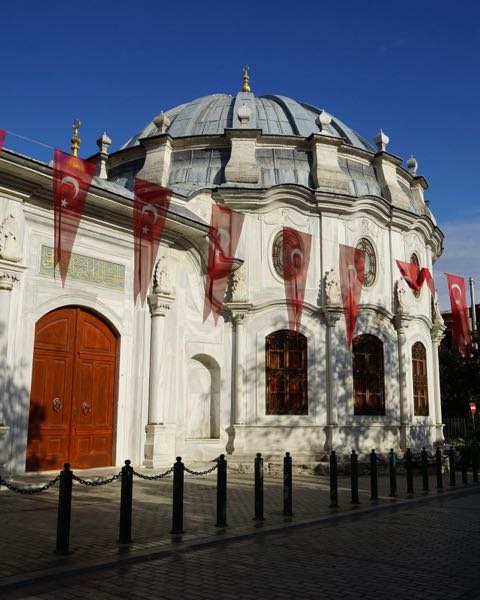
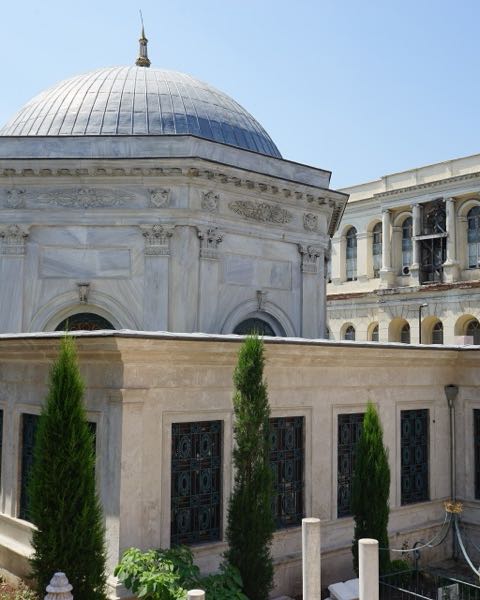
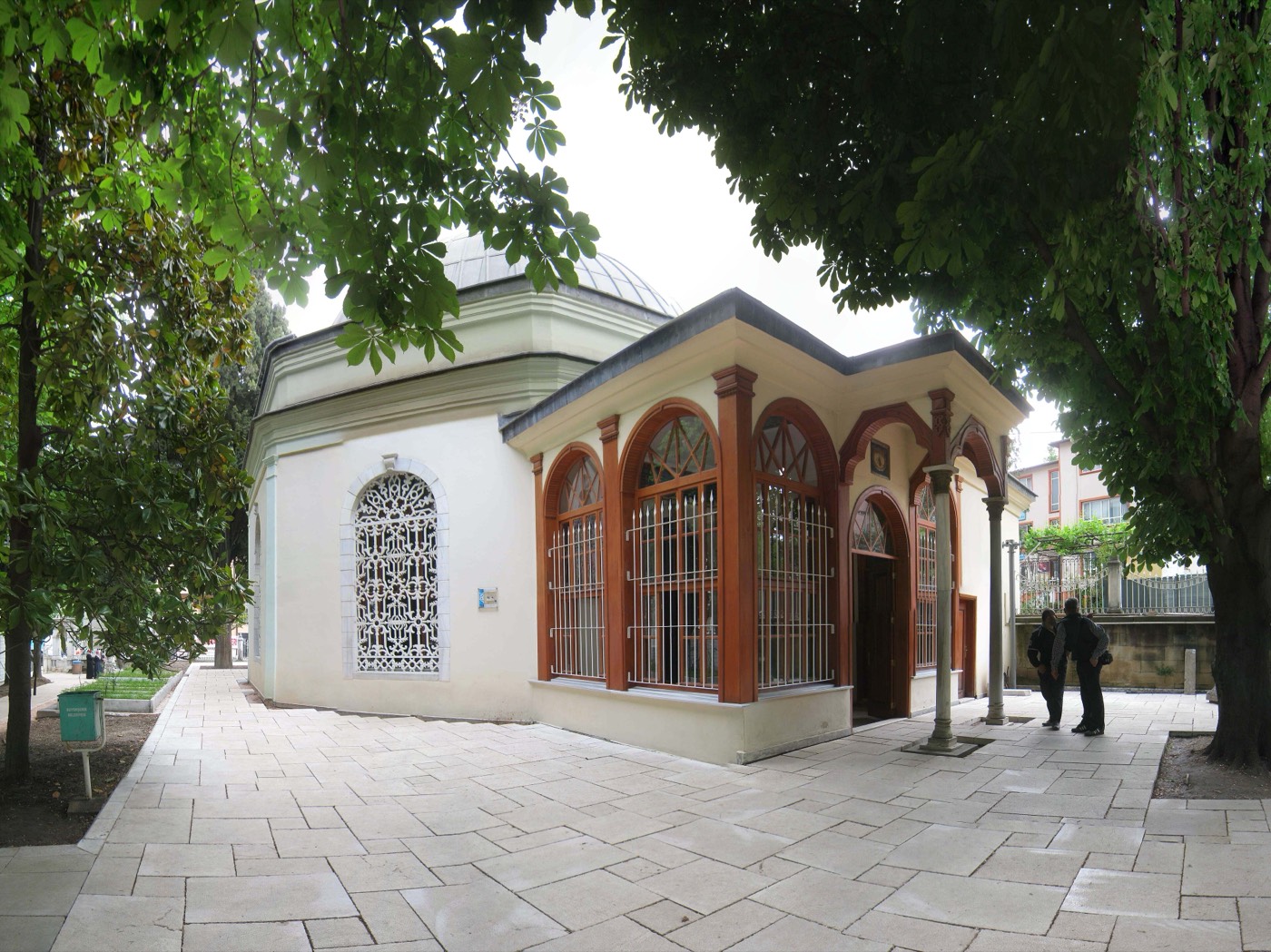
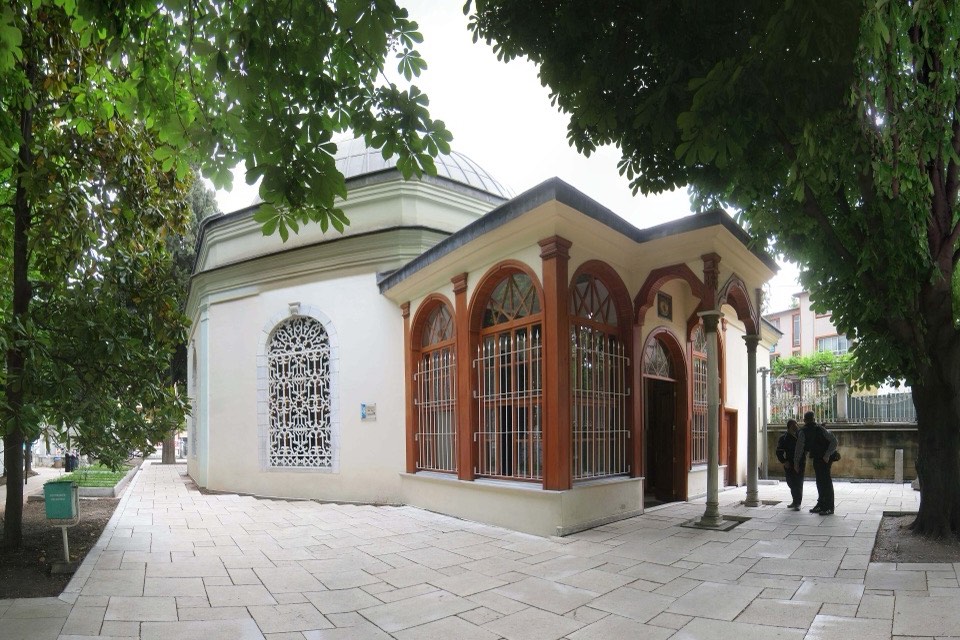
Osman Gazi's tomb is octagonal in body, drum and dome, built of cut küfeki limestone, with walls 1.20 m thick around an interior 10 m across2,4,8. It is entered from the north through a porch on two slender colonnettes carrying Abdülaziz's tughra and a rectangular hall with wooden arches, beside which, to the west, is a room for the tomb keeper2,4. A few steps lead down into the tomb, lit by seven round-arched windows with marble frames, keystones carved with volutes and cast-iron grilles2,4,8. Each segment of the dome is decorated with two garlands4. The ten-line inscription was composed by Osman Nevres and written in ta'lik script by the Mevlevi calligrapher Zeki Dede4.
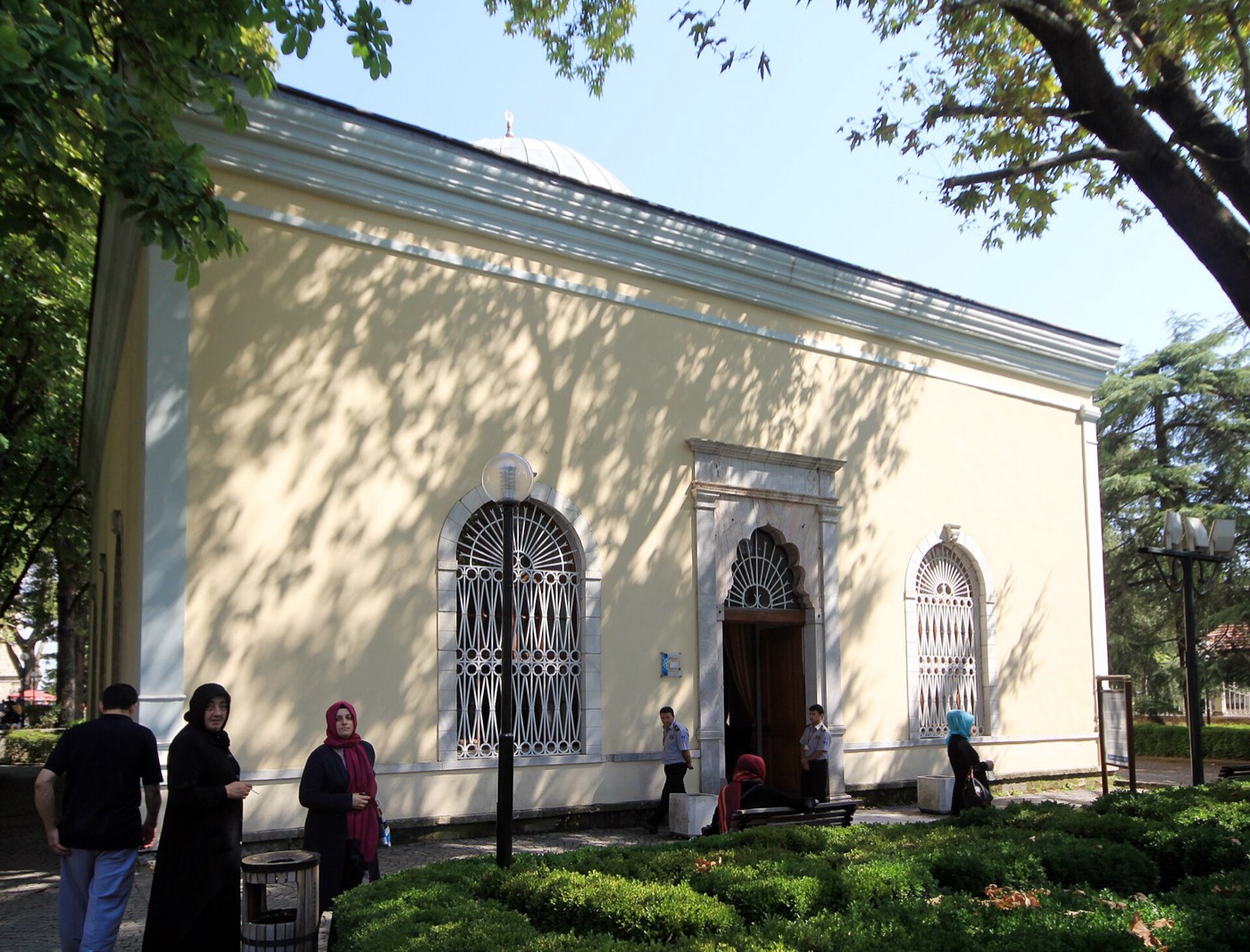
Orhan Gazi's tomb, east of Osman's, is a square building 16.80 m on each side, with walls 1.30 m thick2,5. Its door, with a lobed arch in a marble frame, opens in the middle of the south side2,5. Inside, four columns linked by arches carry a small central dome, surrounded by a barrel-vaulted ambulatory, a plan that TDV compares with the Bursa tombs of Murad I and Murad II2,5. Court records show that the earlier building had several domes5,9. Old pictures show that it too once had a porch on two colonnettes and an entrance hall5. ICOMOS noted that the domes of both tombs date from after the earthquake3.
Inside
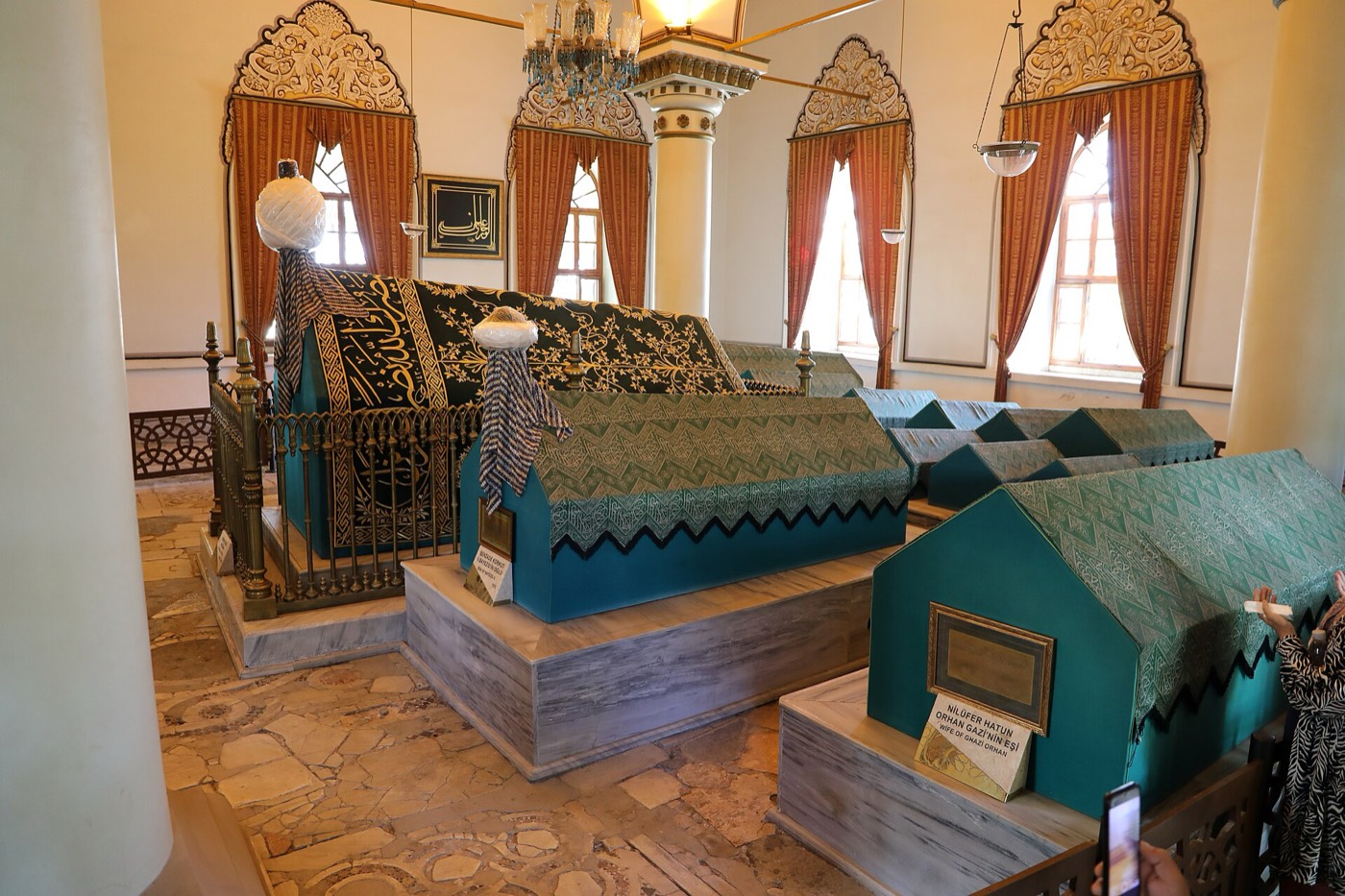
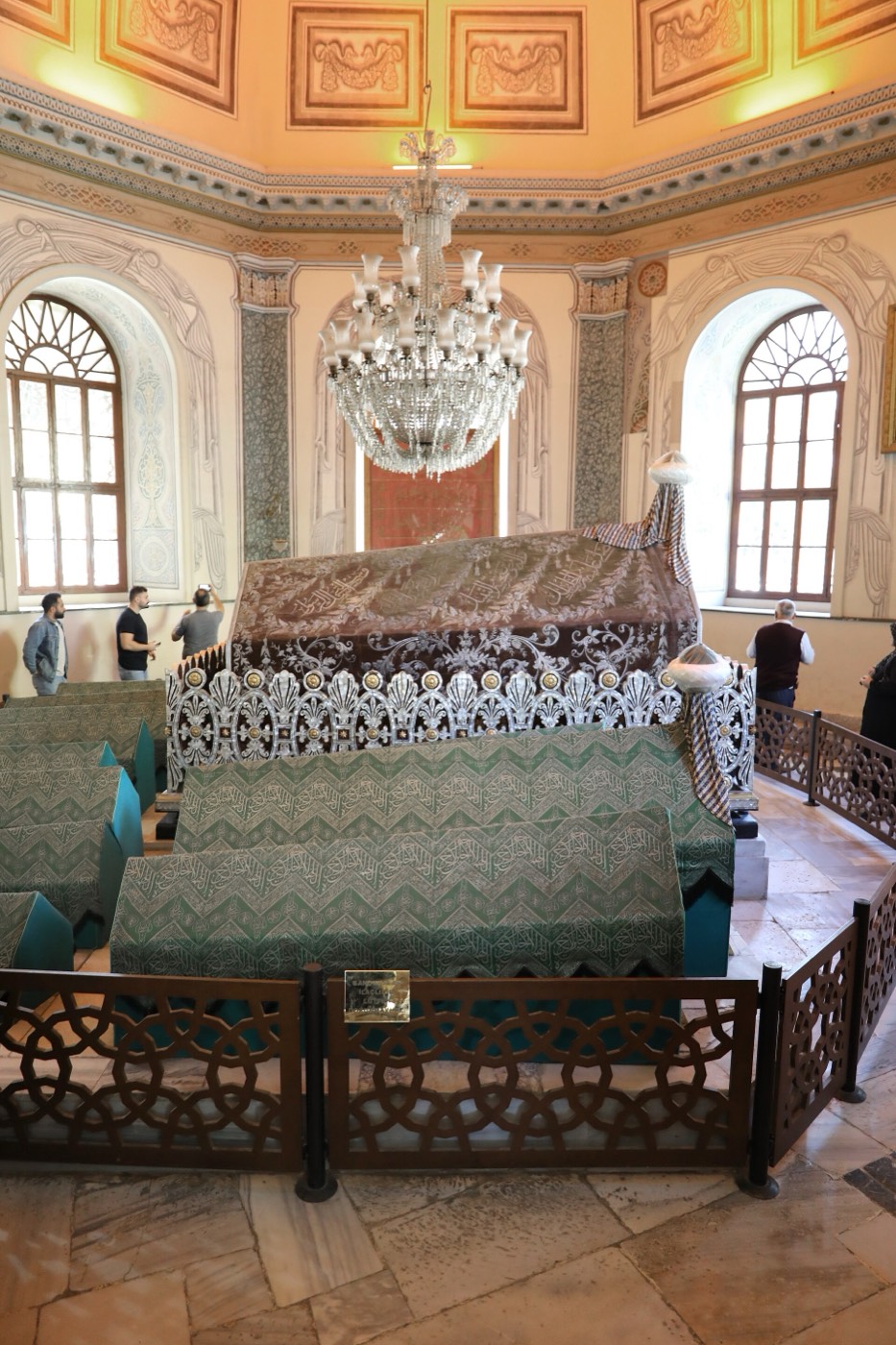
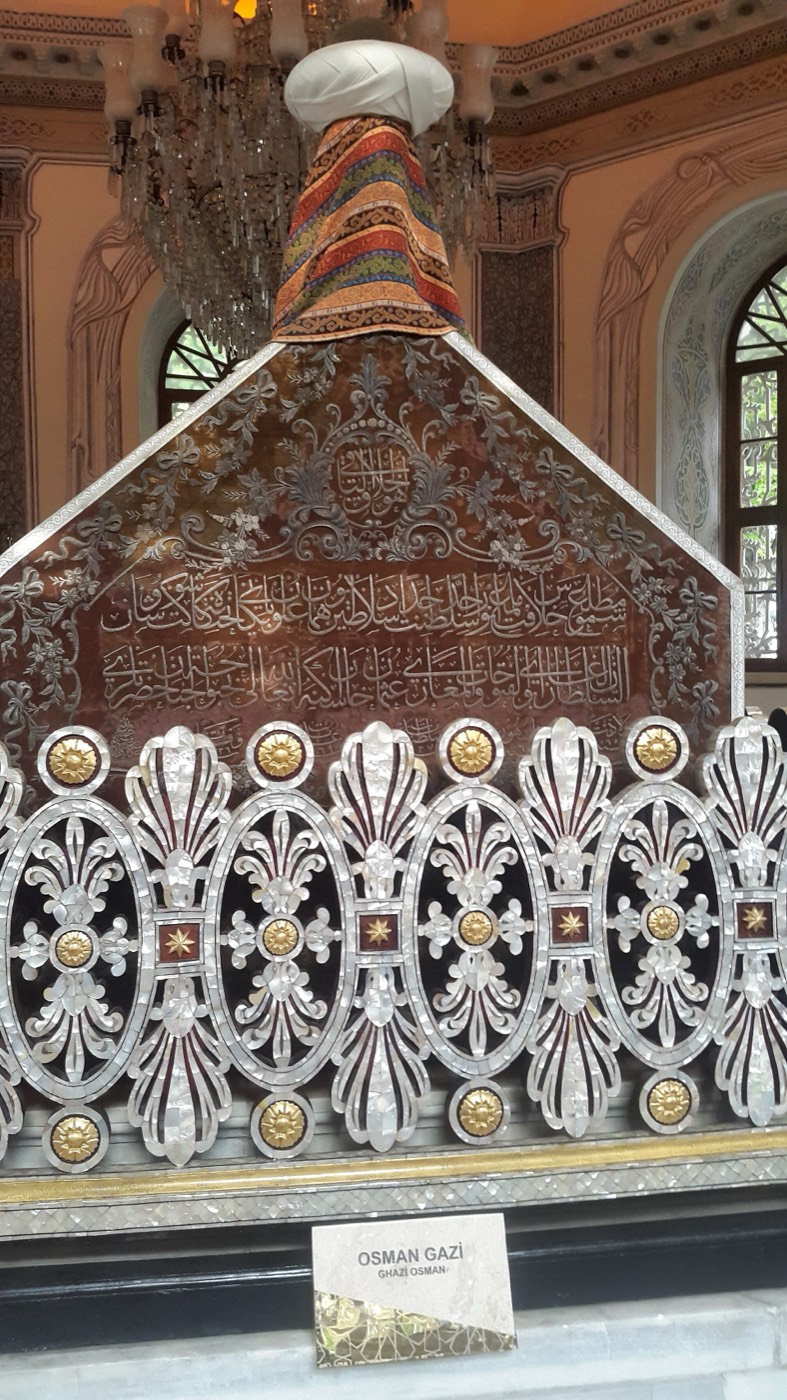
In Osman Gazi's tomb the painted decoration is simple and has been renewed in repairs, and the corner pilasters look like green marble4. His wooden cenotaph, inlaid with mother-of-pearl, stands in the middle inside a mother-of-pearl screen last repaired in 2004, under a velvet cover embroidered in silver that Kültür Portalı links with Abdülaziz's visit to Bursa4,8. The sixteen other cenotaphs include those of his son Alaeddin, Orhan's wife Asporça Hatun, her son İbrahim and Savcı Bey, a son of Murad I4,8. Orhan Gazi's tomb is whitewashed inside, with baroque motifs over the windows and on the pendentives, and fragments of the Byzantine church's mosaic floor are still visible2,5,9. His cenotaph lies at the centre inside a brass screen, among 20 others that include those of his wife Nilüfer Hatun and his son Kasım5,9.
What to look for
- Abdülaziz's tughra on the porch of Osman Gazi's tomb4.
- Osman Gazi's cenotaph and its screen, both inlaid with mother-of-pearl4,8.
- Fragments of the Byzantine church floor inside Orhan Gazi's tomb2,5,9.
- The four-column domed core and vaulted ambulatory of Orhan Gazi's tomb5.
- The 1863 chronogram inscription composed by Osman Nevres and written by Zeki Dede4.
Visiting
- Both tombs stand in Tophane Park in Bursa's Osmangazi district, inside the old citadel (Hisar)2,8,9.
- They form the component ‘Khans Area (Orhan Ghazi Tombs)’ of the World Heritage property ‘Bursa and Cumalıkızık: the Birth of the Ottoman Empire’, inscribed in 20141.
- The square in front of them was called Meydan-ı Osmaniye in Ottoman times2.
Official information: General Directorate of Foundations (Vakıflar Genel Müdürlüğü), owner of the tombs; the nomination file's 2012 inventory names the Bursa Metropolitan Municipality as responsible for their upkeepDirectionsOpen in OpenStreetMapGuided tours in Bursa