History
Ahmad Shah, the ninth Bahmani king, moved his capital from Gulbarga (now Kalaburagi) to Bidar and settled there in 14291,7. He favoured the Sufi saint Shah Ni‘mat-Allah of Kirman, who sent his grandson to Bidar with a letter addressing the king as Wali, “friend of God”1. Ahmad Shah also paid for the saint’s mausoleum at Mahan in Iran5. When he died in 1436 his son ‘Ala-ud-Din raised a lofty dome over his grave at Ashtur, a village in the lowlands about 2.8 km east of Bidar1. It became the burial ground of the dynasty, and tombs were added there until 15351,2.
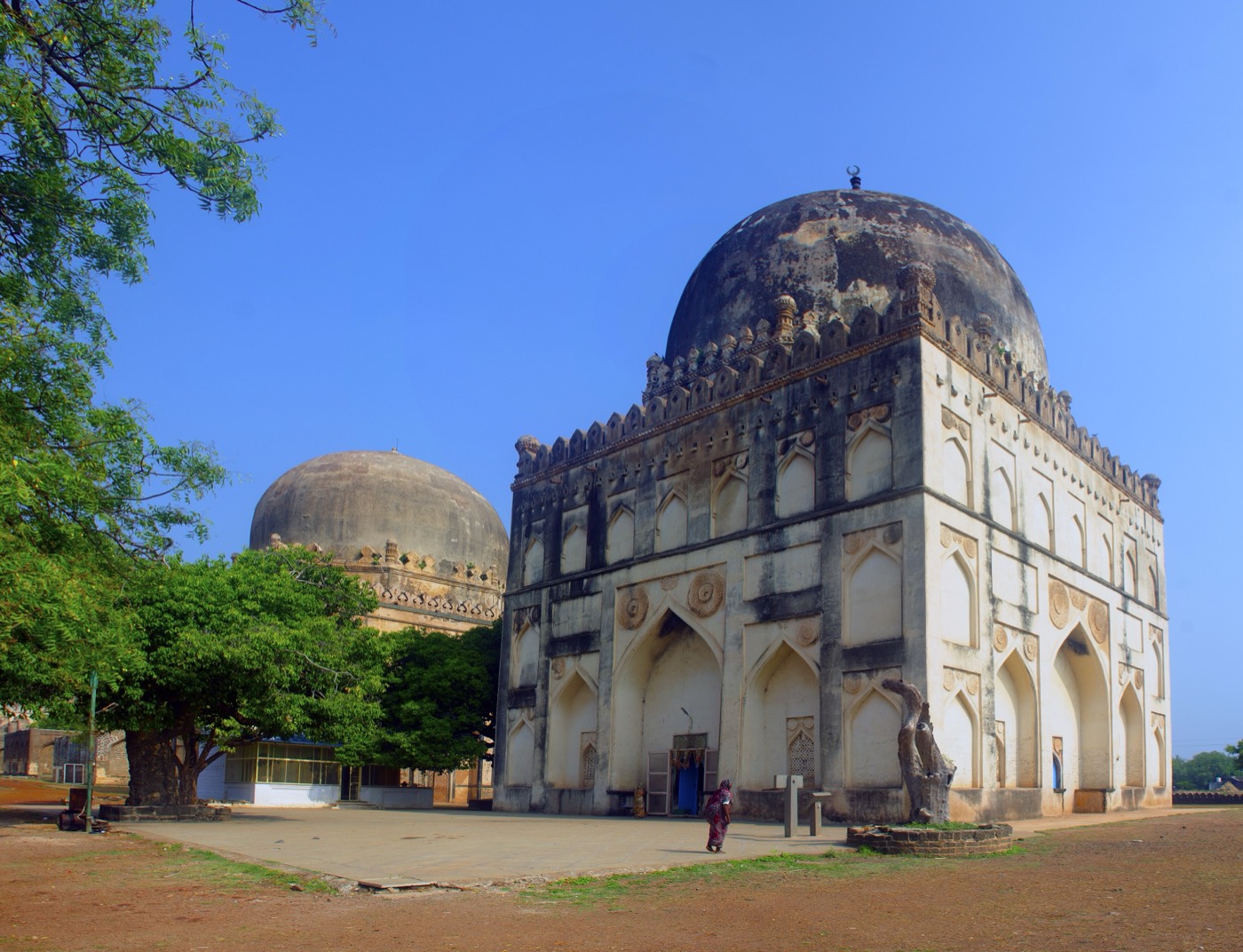
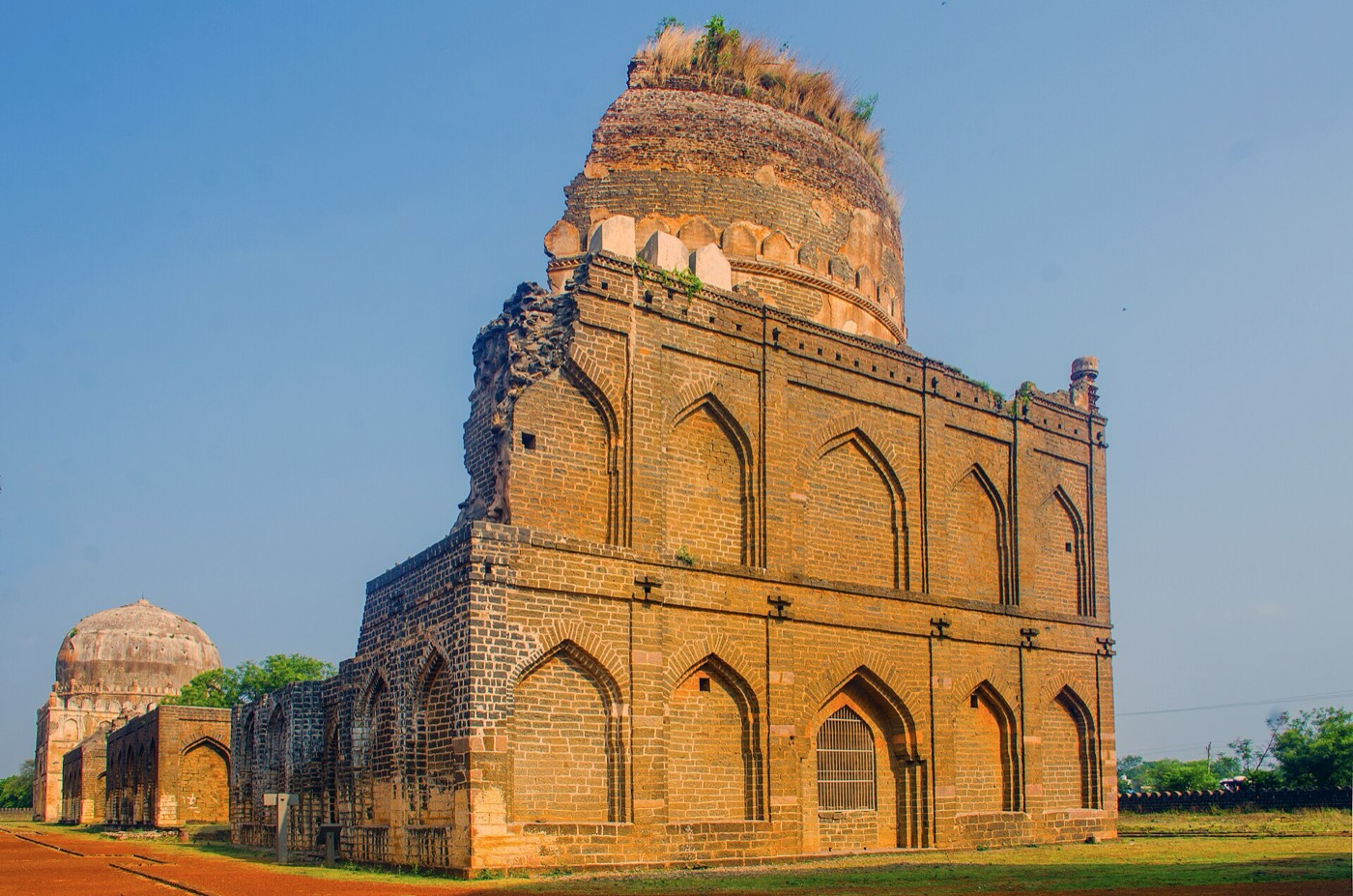
Yazdani counted eight tombs of Bahmani kings at Ashtur, a figure Britannica repeats; Marshall and UNESCO’s tentative-list text speak of twelve royal tombs1,8,6,2. Their size follows the dynasty’s fortunes1. The tombs of Ahmad Shah, ‘Ala-ud-Din, Humayun (d. 1461) and Mahmud Shah (r. 1482-1518) stand on bases about 77 ft (23.5 m) square, while those of the boy kings Nizam Shah and Muhammad Shah III were never finished1. The last kings, puppets of their Barid ministers, received small tombs with conical domes1. In 1947 Yazdani recorded that Ahmad Shah’s tomb still drew an annual ‘urs, attended by Lingayat devotees as well as Muslims1.
Architecture
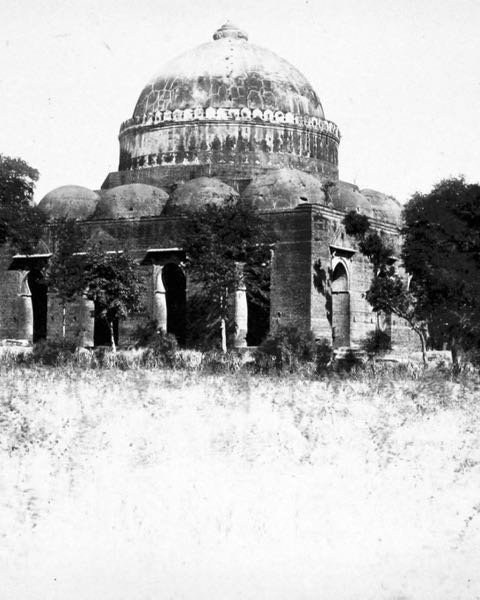
The tombs are square halls under domes, built of trap masonry; Humayun’s, for one, is of black trap laid in lime1. Ahmad Shah’s tomb is 77 ft 1 in (23.5 m) a side, with battered walls 12 ft 6 in (3.8 m) thick that rise 57 ft (17.4 m) above the floor1,3. Its dome, three-quarters of a sphere, stands on an octagonal drum and reaches 107 ft 9 in (32.8 m) above the ground with its finial1. Yazdani compared the dome and finial with those of the Lodi tombs at Delhi1. Tall arches open on the north, south and east, and stucco in the spandrels is the only ornament outside1,3.
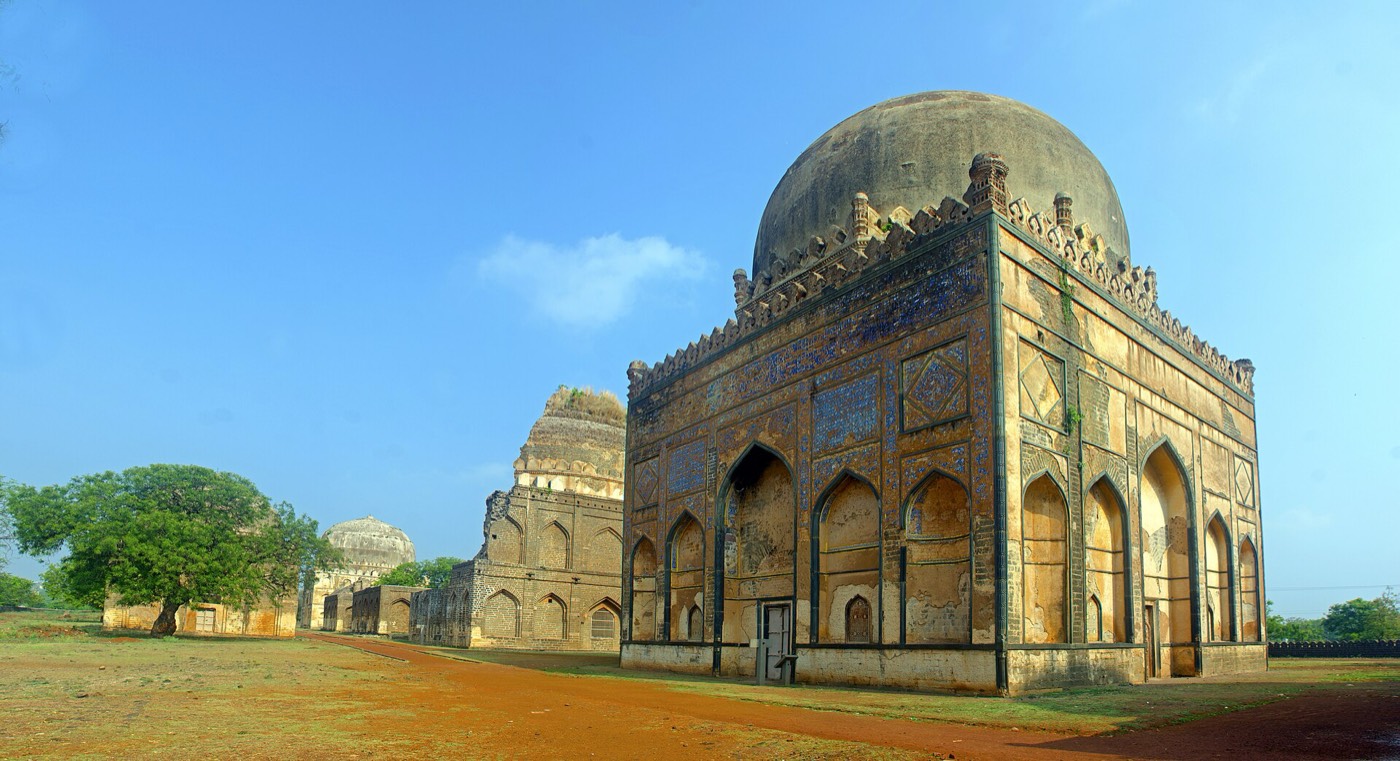
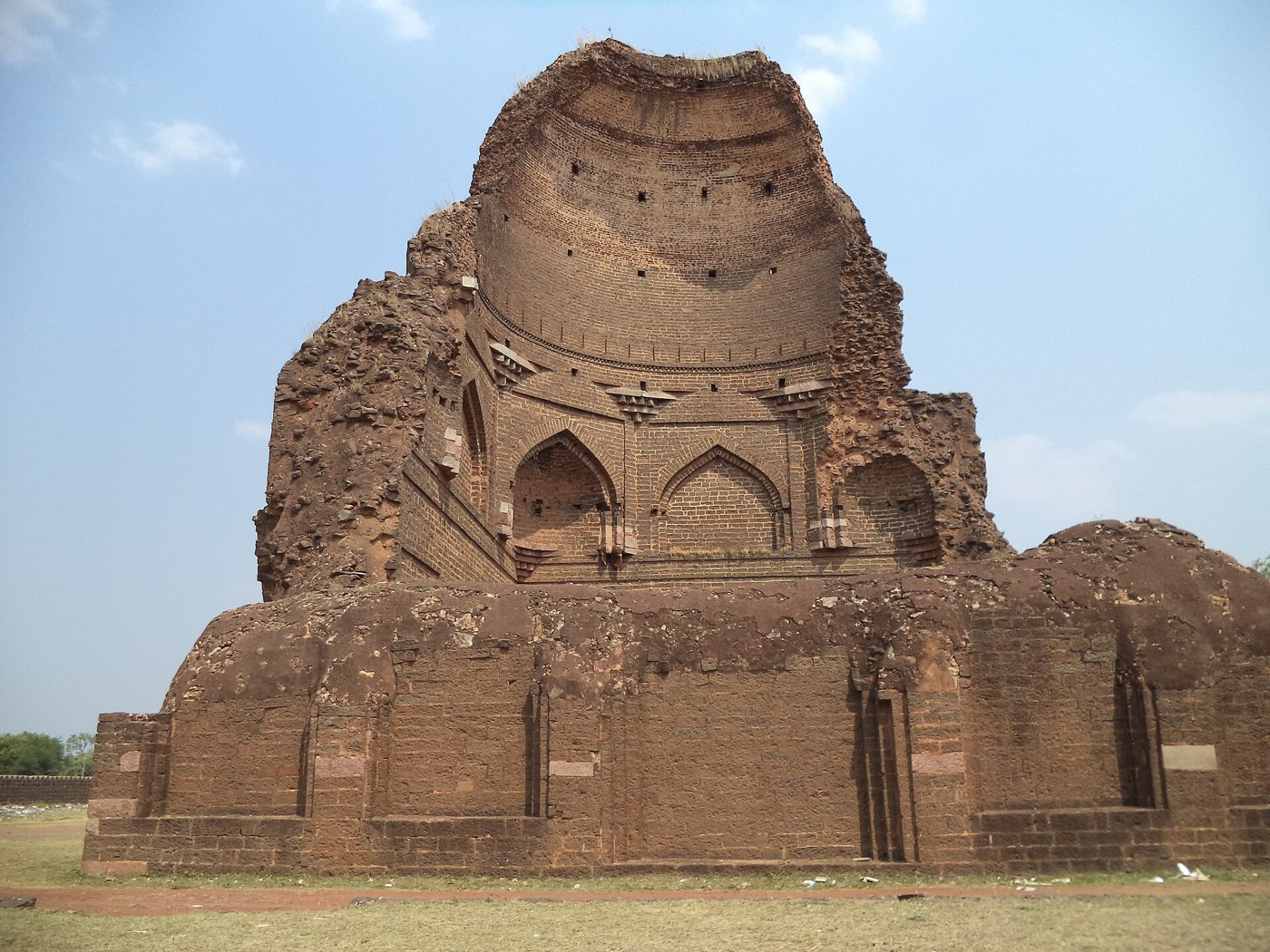
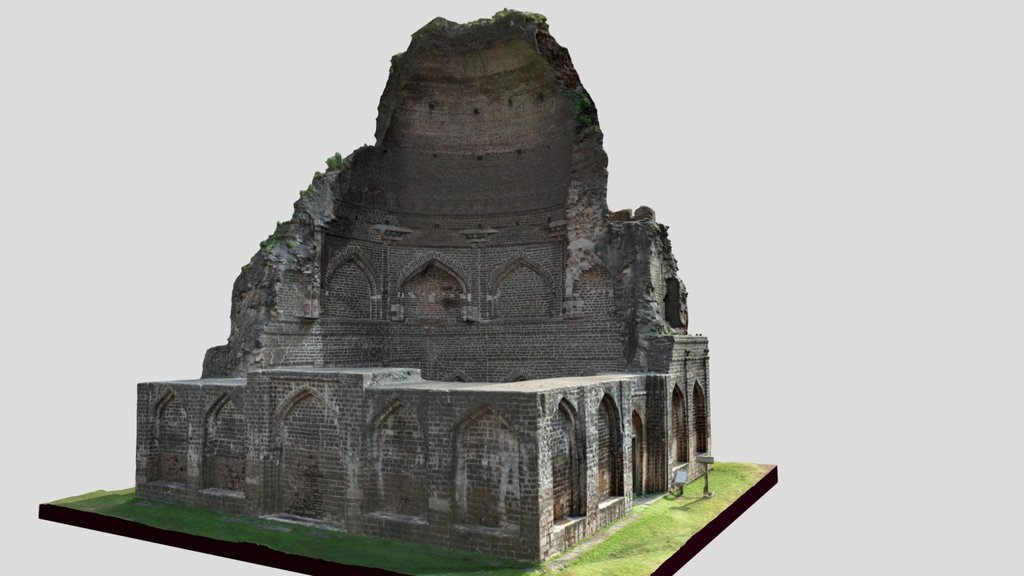
The tomb of ‘Ala-ud-Din next to it keeps traces of glazed tile panels in blue, green and yellow on white, framed by polished black stone bands carved with key and rope patterns1. Archnet notes it as the first use of mosaic tile at Bidar4. Humayun’s tomb was struck by lightning, which brought down most of its dome; the break shows rings of masonry thinning towards the top, with upper courses of light porous bricks that float in water1. Mahmud Shah’s tomb is plain, its walls lined with three rows of arched niches1. Yazdani concluded that Persian designers and largely Hindu masons built these tombs1.
Inside
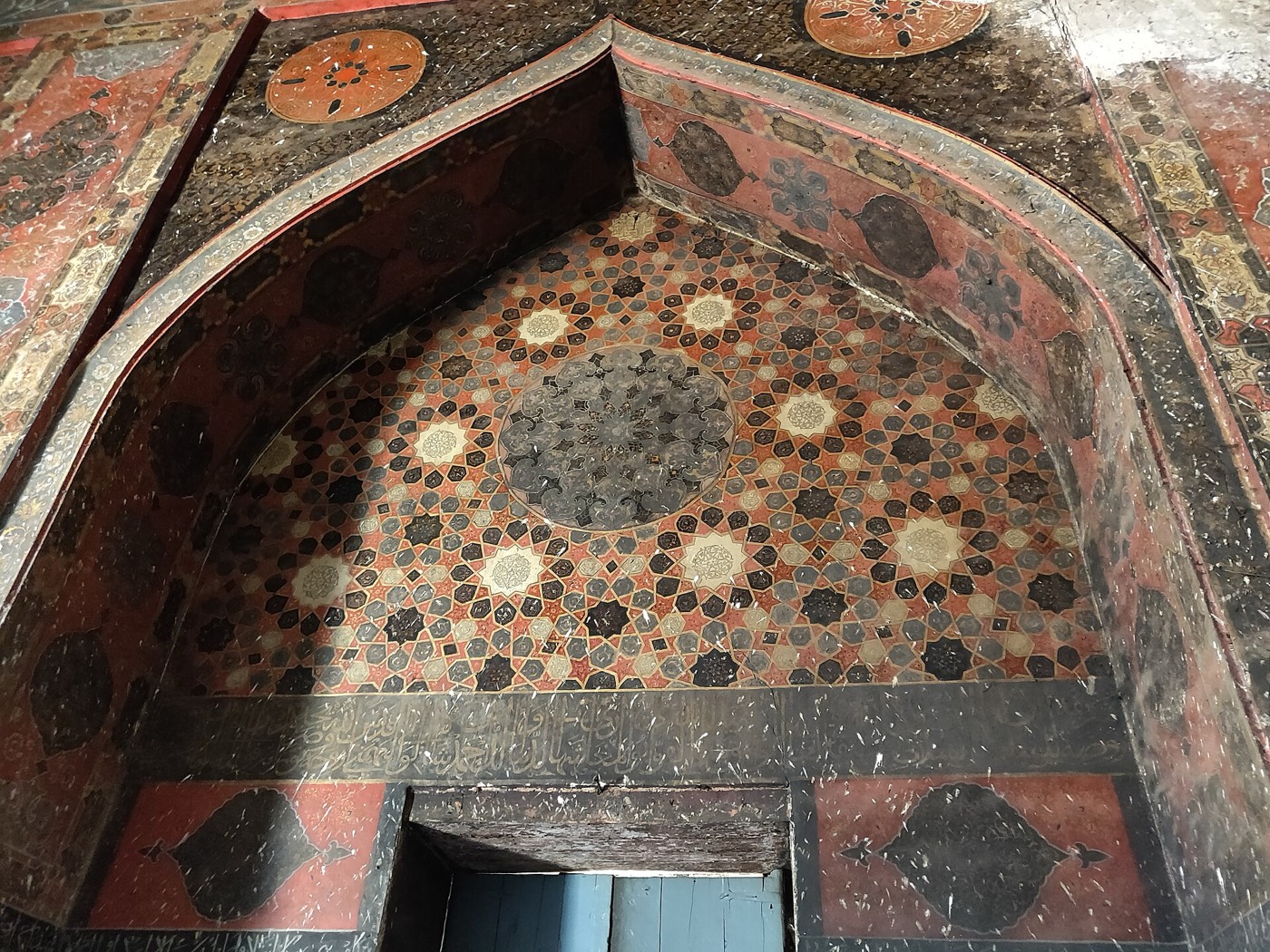
Inside Ahmad Shah’s tomb the hall is 52 ft 2 in (15.9 m) square; squinches turn it into an octagon and then into a 24-sided figure below the dome1. Walls and vault are painted in gold and vermilion with shades of cobalt and green, in floral and geometric panels and bands of Kufic and thuluth script; Marshall described letters of gold on deep blue or vermilion1,6. The texts include Sufi verses by Shah Ni‘mat-Allah and his lines of spiritual descent1,5. One inscription names the painter, Shukr-Allah of Qazwin; another gives the king’s accession in 825 AH (1422) and death in 839 AH (1436)1. By 1947 leaks had effaced parts of the north and west walls, and the dado paintings had been redone in modern colours1.
What to look for
- The painted vault of Ahmad Shah’s tomb, with its bands of Sufi texts in gold1,5.
- The painter’s name, Shukr-Allah of Qazwin, in an inscription inside Ahmad Shah’s tomb1,3.
- Traces of glazed tile and carved black stone bands on ‘Ala-ud-Din’s tomb1,4.
- Humayun’s broken dome, which shows how the domes were built in rings1.
- The unfinished walls of the tombs of the boy kings Nizam Shah and Muhammad Shah III1.
Visiting
- Ashtur lies about 2.8 km east of Bidar town, reached by the road from the Dulhan Darwaza1.
- About three furlongs (600 m) before the royal tombs, on the town side, stands the Chaukhandi, tomb of Shah Khalil-Allah, son of Shah Ni‘mat-Allah1.
- The ASI lists the tombs among the centrally protected monuments of its Hampi Circle; they also belong to the Bidar component of “Monuments and Forts of the Deccan Sultanate”, on India’s UNESCO Tentative List since 20149,2.
Official information: Archaeological Survey of India (ASI), Hampi CircleDirectionsOpen in OpenStreetMapGuided tours in Bidar