History
Alivardi Khan, whose father was of Arab descent and whose mother came from the Turkic Afshar tribe of Khurasan, took power in Bengal by defeating and killing Nawab Sarfaraz Khan at Giria on 10 April 17402,5. Much of his sixteen-year reign went into wars with the Marathas, ended in 1751 by a treaty that ceded them Orissa and paid them 12 lakhs of rupees a year2,5. He died in April 1756, aged nearly eighty, and was buried at his mother’s feet in the garden of Khushbagh, opposite Motijhil2,5. Banglapedia adds that this first grave stood on a small raised platform in the centre of the outer enclosure8.
His grandson Siraj ud-Daulah, born in 1733 to Amina Begum, ruled for little more than a year2,6. According to Banglapedia he built the present mausoleum for Alivardi and his family and had Alivardi’s body moved into it8. After the battle of Palashi (Plassey) against Robert Clive on 23 June 1757 he fled towards Patna, but was caught and killed at Murshidabad at the instance of Miran, son of Mir Jafar, on the night before 3 July 17572,6. His body was paraded through the city on an elephant, past his mother’s house, and buried at Khushbagh2,3. His widow Lutf-un-nisa Begum, banished to Dhaka after his fall, was later recalled and placed in charge of the cemetery2.
Architecture
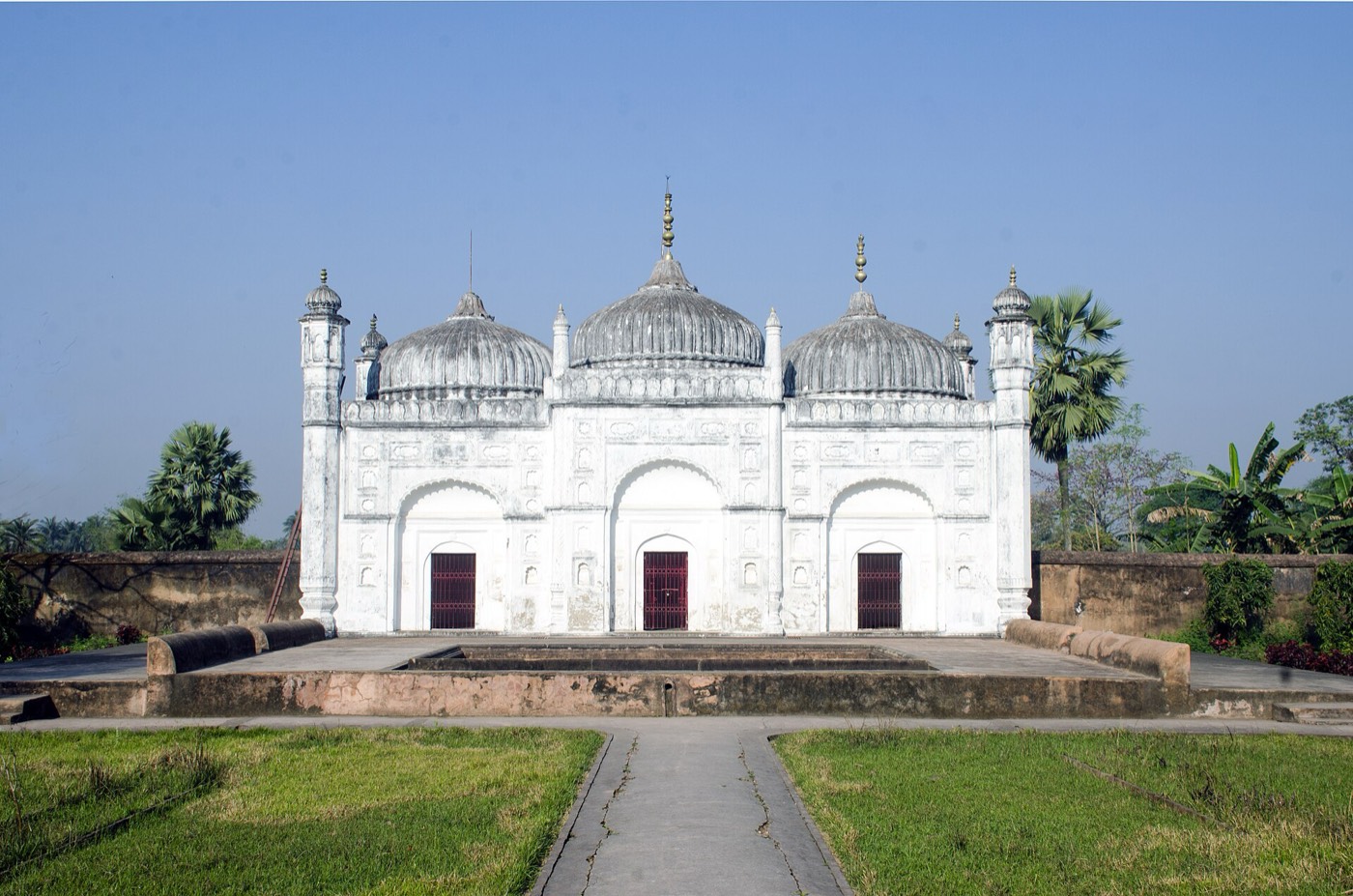
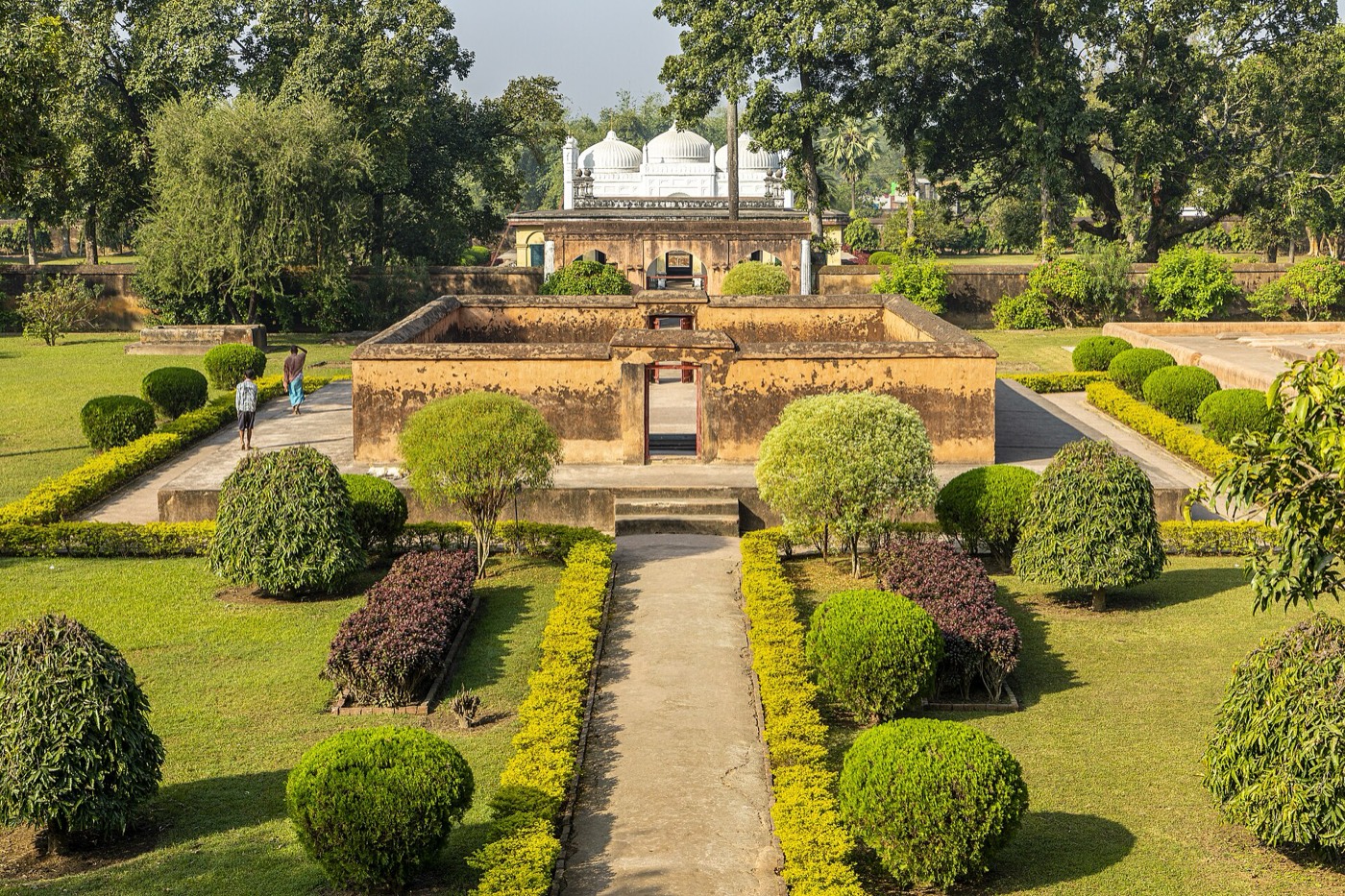
Khushbagh, the “garden of happiness”, lies about three miles west of Motijhil, on the west bank of the Bhagirathi opposite Amaniganj2,3,7. It consists of three walled enclosures2,8. The outer one is entered by a gateway on the east, in front of which are the ruins of an old ghat that led down to the Bhagirathi when the river ran under the walls; the wall facing the river is loopholed for musketry and flanked by octagonal bastions2,3. Inside, the grounds are laid out as gardens, with hedges along the walks2. The middle enclosure is the principal cemetery, with the mausoleum at its centre2,3,8. A large mosque with a terrace in front stands in the compound3.
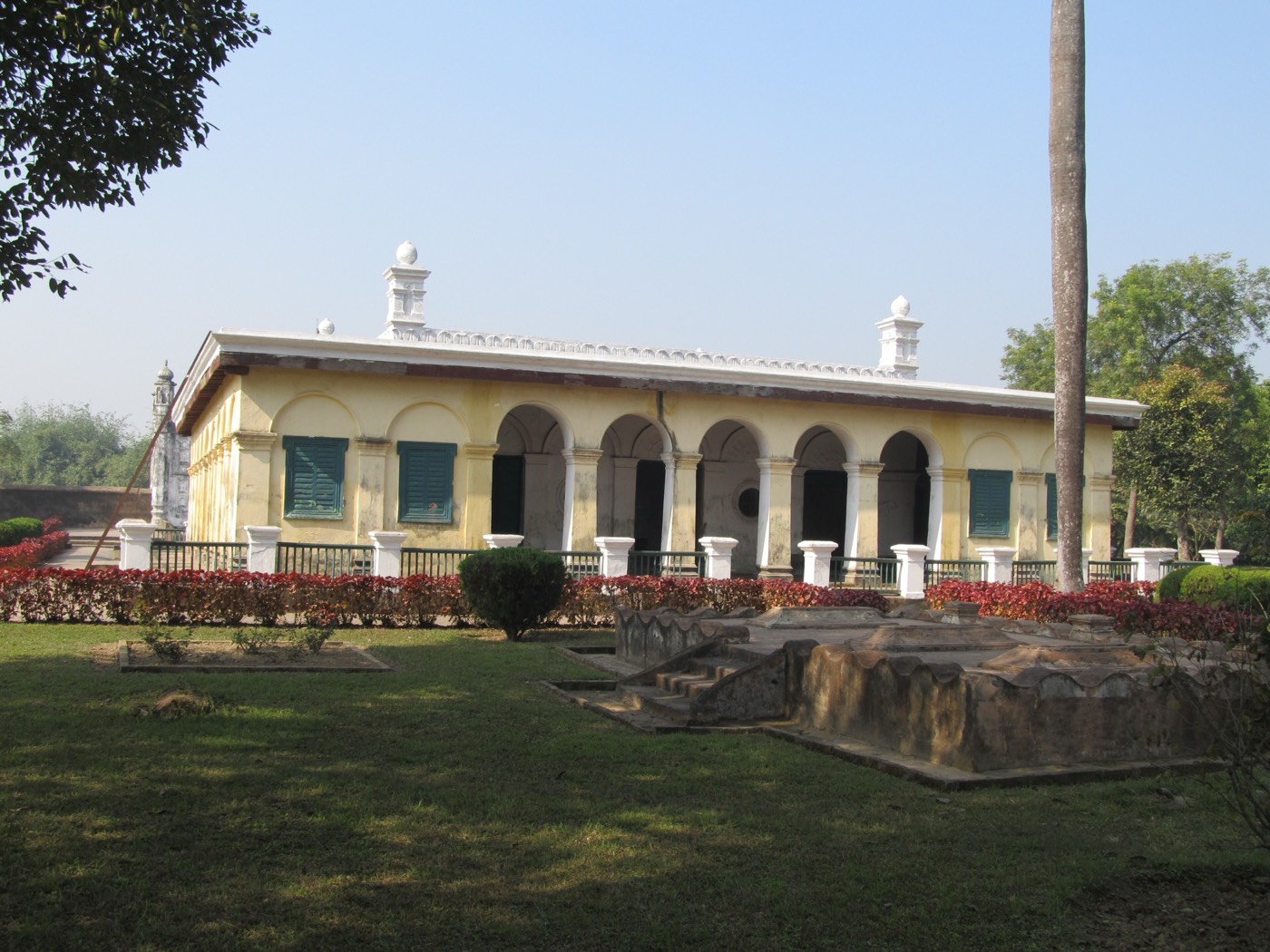
Banglapedia describes the mausoleum as a square, flat-roofed brick building raised two feet above the ground and reached by small flights of steps on the east and west, with an arcaded veranda of five arched openings on each face around a square central chamber that holds Alivardi Khan’s grave8. Apart from four small minarets at the corners and the projecting eaves, it finds that the tomb looks like a British-style bungalow, and that its internal arrangement is a simpler version of the Tomb of Pari Bibi in Dhaka8. The 1896 government list of monuments judged that it had “no architectural merit”4. Majumdar (1905) records that Alivardi Khan had endowed two villages, Bhandardaha and Nawabganj, for its upkeep, and that by his time the government maintained it3.
Inside
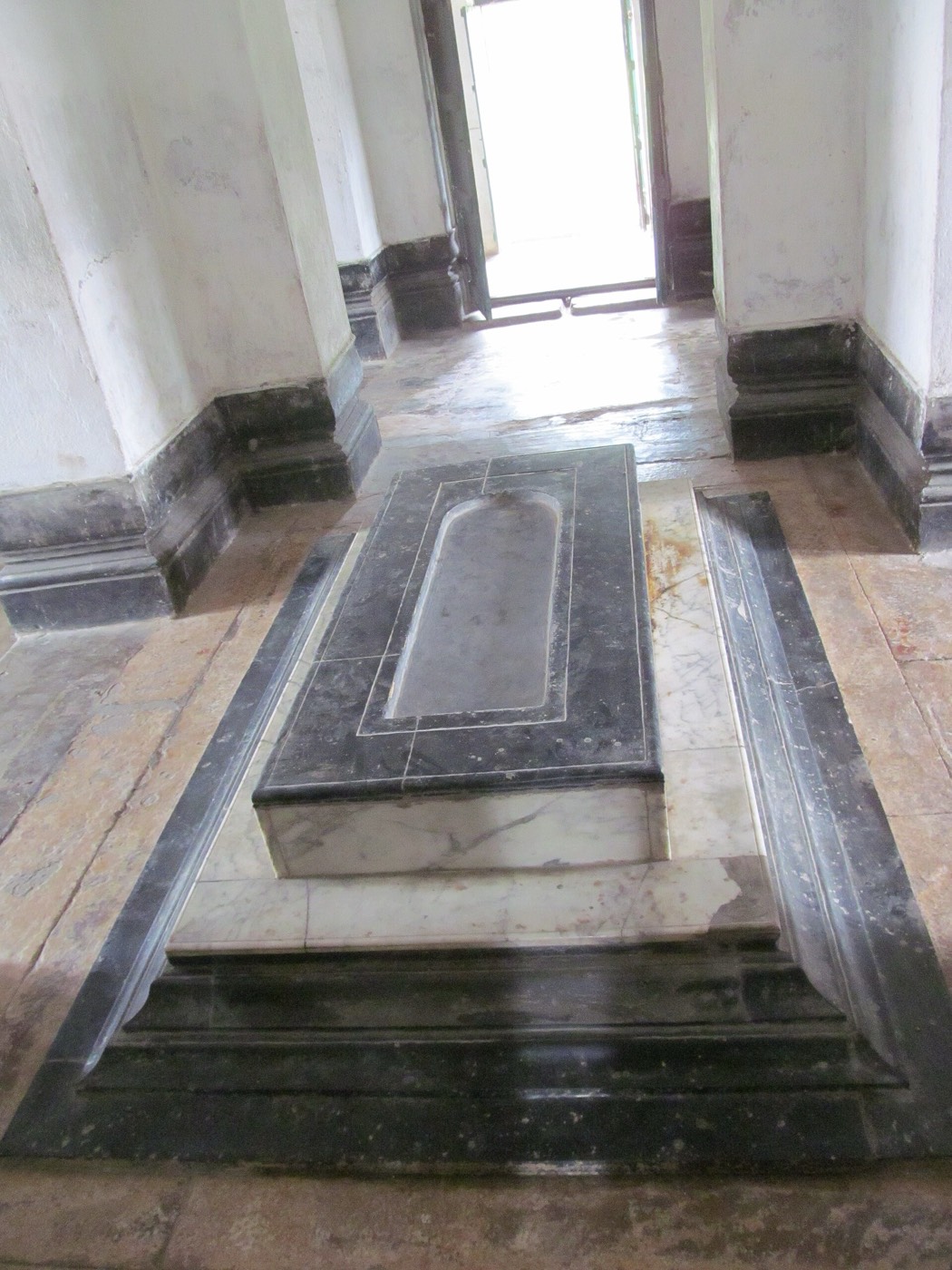
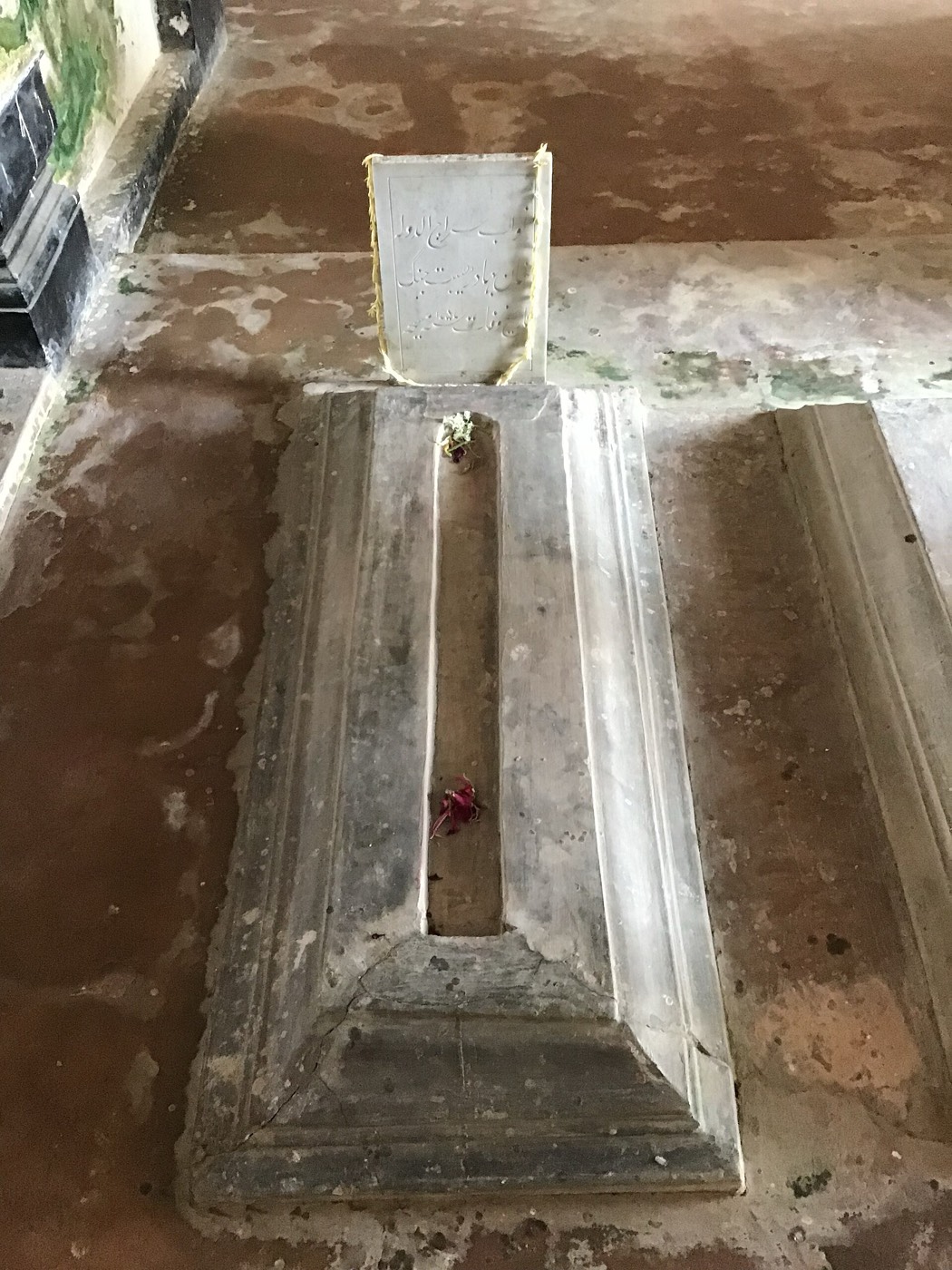
Majumdar (1905) gives the layout of the graves in the mausoleum: Alivardi Khan’s, the central and largest, with Siraj ud-Daulah’s immediately to the east, so that grandfather and grandson lie side by side3. In a second row lie Alivardi’s wife and Lutf-un-nisa Begum; the graves at the ends of the two rows are attributed to Alivardi’s daughters and, with a question mark, to a Mirza Mehdi and his wife, and Majumdar warns that the minor identifications are uncertain3. By 1905 the government had put up marble tombstones3. Alivardi’s mother is buried at Khushbagh too; Banglapedia places her grave in the centre of the outer enclosure3,8. The outer enclosure holds eighteen more graves, only two of them inscribed2.
What to look for
- The graves of Alivardi Khan and Siraj ud-Daulah, side by side in the central mausoleum2,3.
- The arcaded veranda, with five arched openings on each face, around the mausoleum’s central chamber8.
- Lutf-un-nisa Begum’s grave next to her husband’s2,3.
- The loopholed river wall with its octagonal bastions2,3.
- The mosque with a terrace in front, in the cemetery compound3.
Visiting
- Khushbagh lies on the west bank of the Bhagirathi, across the river from the Motijhil and Amaniganj side of Murshidabad2,3,7.
- The later Nawabs, from Mir Jafar to Humayun Jah, are buried in the Nizamat cemetery at Jafarganj, a mile north of the Nawab’s palace2.
- The ASI protects the tomb and mosque of Alivardi Khan and the tomb of Siraj ud-Daulah as one monument1.
Official information: Archaeological Survey of India, Raiganj Circle (protected monument)DirectionsOpen in OpenStreetMapGuided tours in Murshidabad