History
Inal was born around 785 AH (1383) and brought from the Caucasus to Cairo with his elder brother, where he was sold to Sultan Barquq; Sultan Faraj later freed him5. After governorships in Syria he became great dawadar under Sultan Jaqmaq in 846 AH (1442) and commander-in-chief in 850 AH (1446)5. While still an amir he built himself a domed mausoleum outside the city, and an inscription at the north-east corner of its exterior records its completion on 1 Muharram 855 AH (3 February 1451)2,4,5. He was proclaimed sultan in Rabi' I 857 AH (March 1453) and died on 26 February 1461, a day after placing his son al-Mu'ayyad Ahmad on the throne5.
As sultan, Inal enlarged the foundation in stages2,4. Marble slabs at the entrance in the north façade date the completion of a large khanqah (Sufi convent) to Muharram 858 AH (January 1454), and an inscription round the madrasa courtyard records that it was begun in Dhu al-Qa'da 859 AH and finished in Rabi' I 860 AH (February-March 1456) under the supervision of Yusuf the majordomo2. Lucian Reinfandt, who studied the endowment deeds, lists a mausoleum for the sultan and his family, a madrasa, a khanqah, a Friday mosque and a zawiya3. Al-Mu'ayyad Ahmad, deposed in 1461, lived mostly in Alexandria thereafter; when he died in 1488 his body was buried in his father’s mausoleum3.
Architecture
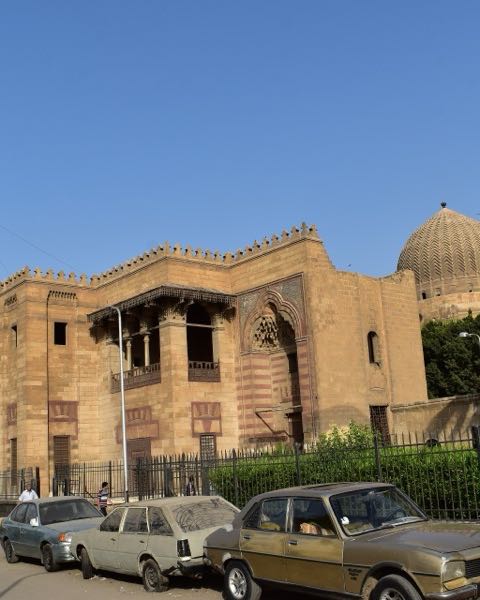
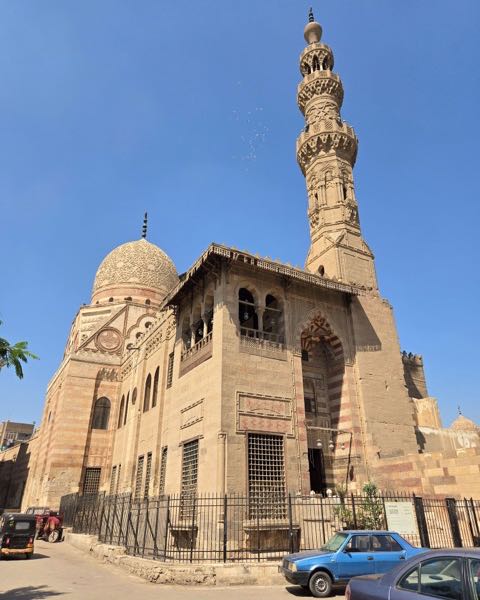
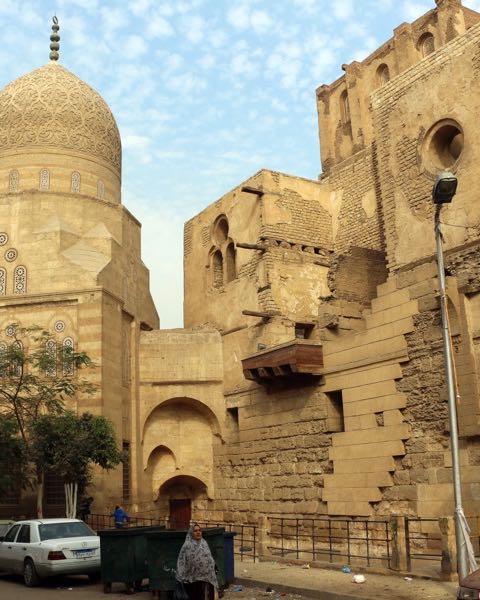
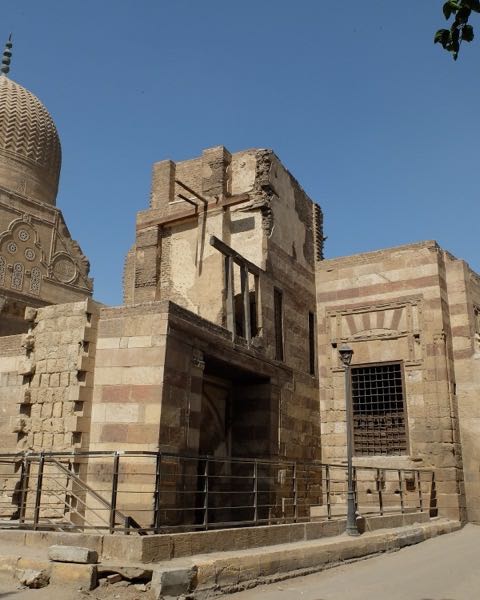
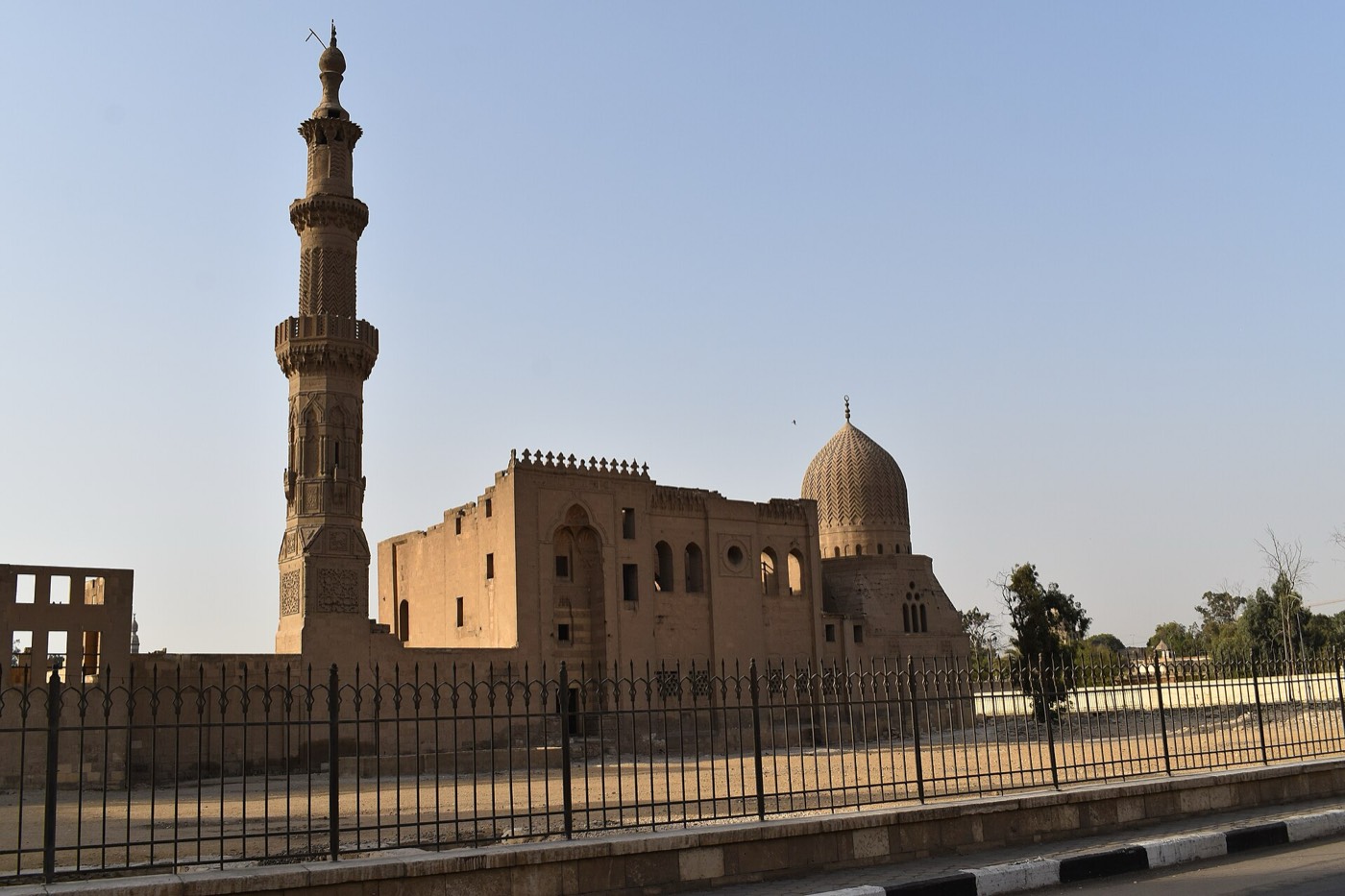
Because the mausoleum, khanqah and madrasa were built at different dates, K. A. C. Creswell observed, the complex has a straggling façade, unusual at a time when Cairene buildings of this kind usually formed an organic whole2. Nasser Rabbat cites it as an example of the accretive nature of Mamluk architecture, and Reinfandt, following Max van Berchem, notes that its completion took a long time and that its design is not homogeneous4,3. Maciej Witkowski describes the foundation, beside the complex of Amir Qurqumas, as much ruined but still imposing6.
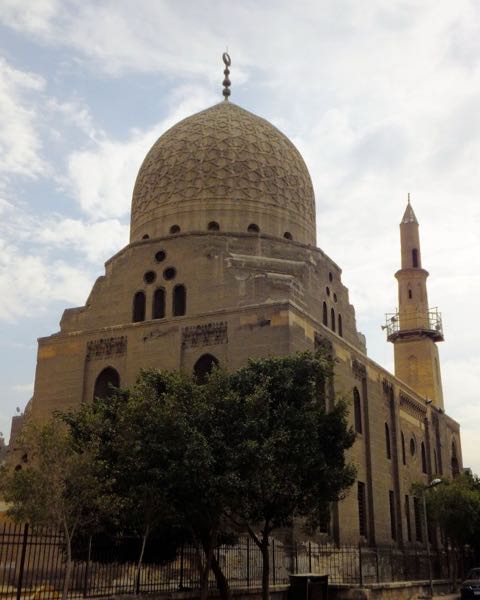
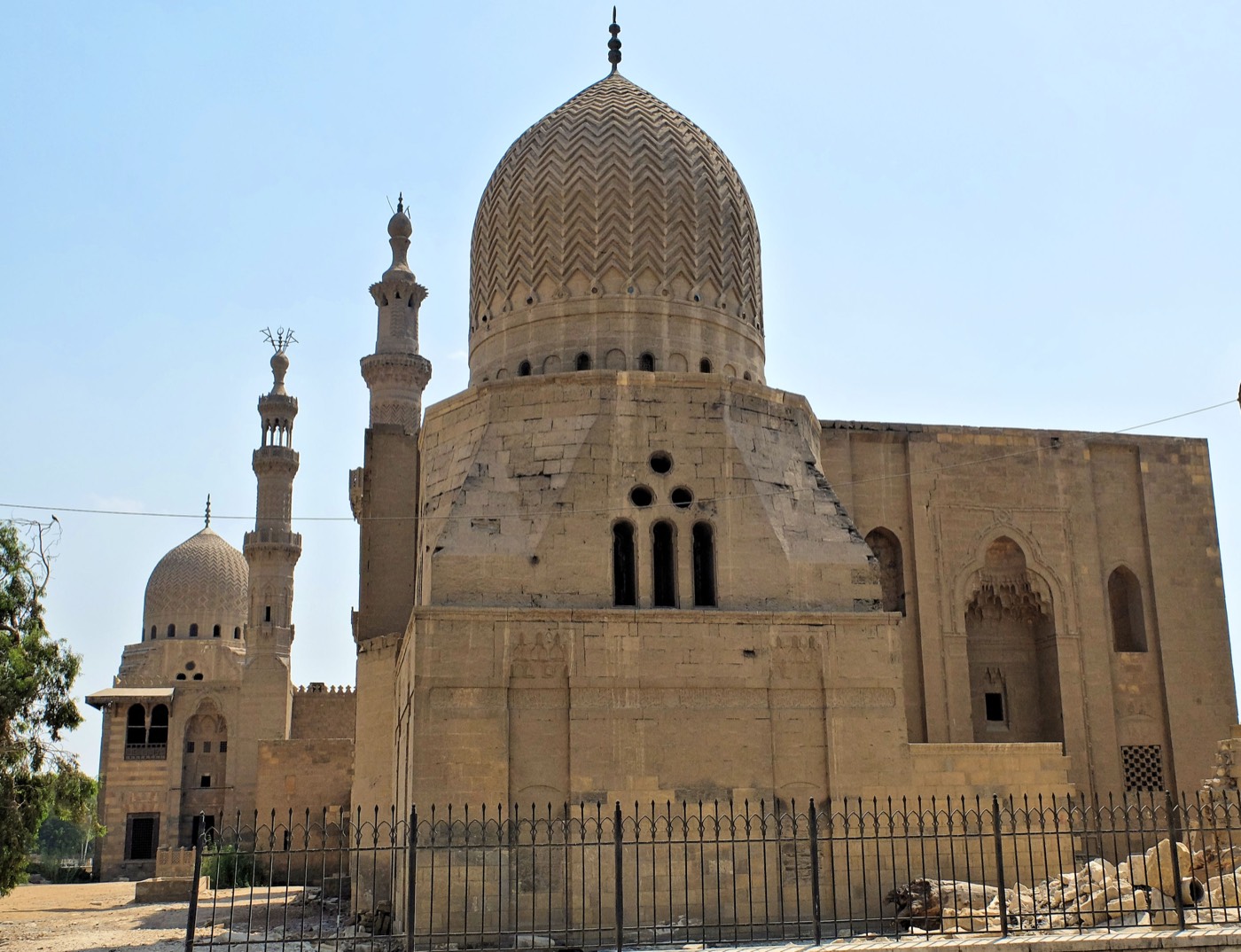
The mausoleum has a tall dome2. Creswell lists among its features groups of three windows between the pendentives, sixteen windows round the base of the dome and an unusual treatment of the outside of the transition from the square base to the circle of the dome, which he found in only a few other Cairene tombs2.
Inside
Inside the mausoleum, the dome rests on pendentives with groups of three windows between them, and a ring of sixteen windows pierces its base2. Creswell already described the khanqah in 1919 as being in an advanced state of ruin2. In 1995 the Polish-Egyptian mission working on the neighbouring Qurqumas complex photographed graffiti written on the walls of one of the Sufi cells of Inal’s complex7.
What to look for
- The tall dome of the mausoleum, finished on 3 February 1451, two years before Inal became sultan2,5.
- The straggling street front, the result of three building campaigns between 1450 and 14562.
- The marble slabs over the north entrance that date the khanqah to January 14542.
- The inscription round the madrasa courtyard naming Yusuf the majordomo as supervisor of the works2.
Visiting
- The complex stands beside the funerary complex of Amir Qurqumas, about 1.5 km from Bab al-Nasr and some 3 km north of the Citadel6. On the Survey of Egypt map reproduced by Leonor Fernandes it is the northern of the two complexes8.
- The complex is no. 158 in the index of Cairo’s monuments drawn up for the Comité (Committee for the Preservation of Arab Antiquities)2.
- UNESCO’s Historic Cairo property includes a component in this cemetery, the ‘Qayitbay Necropolis’ (89-005)1.
DirectionsOpen in OpenStreetMapGuided tours in Cairo
In a trip guide: Cairo’s City of the Dead and the medieval city