History
Ahmad Shah served the Persian ruler Nader Shah Afshar as a general in his campaigns into India, and in 1747 an assembly of Pashtun chiefs elected him their leader2. He ruled an empire from Kandahar, the city he laid out to replace Nadirabad, and Afghans still call him Ahmad Shah Baba, Father of Afghanistan1. In 1768 he received the cloak held to be the Prophet Muhammad's from Murad Beg, Amir of Bukhara, as part of a treaty that settled his northern borders1. He died in 1772 after falling ill in the hills east of Kandahar; Nancy Hatch Dupree attributes his death, at 50, to a cancer of the face that followed a battle wound1.
His son Timur Shah succeeded him and in 1776 moved the capital to Kabul1,2. According to the Aga Khan Trust for Culture (AKTC), Timur Shah built this mausoleum for his father, and its plan and section resemble those of Timur Shah's own tomb in Kabul2. It adjoins the shrine of the Kherqa Sharif, which houses the cloak and which Dupree in 1977 called one of the holiest shrines in Afghanistan1. Her guide of that year calls the mausoleum the most important historical monument in Kandahar1.
Architecture
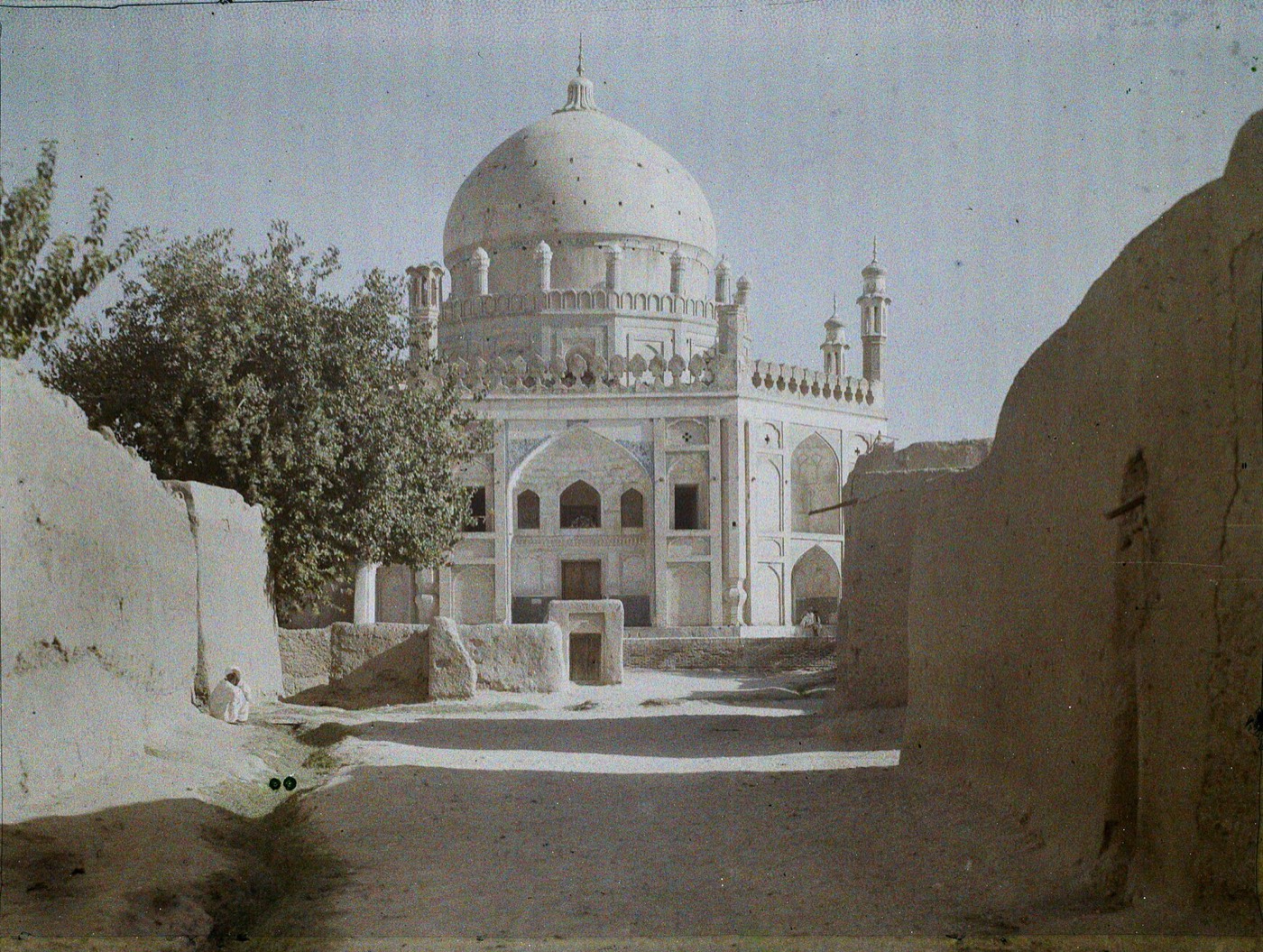
The mausoleum is an octagon standing on a basalt platform1. Its plain beige brick walls are broken by many niches of different heights and depths, edged with tile in yellow and green or green and blue1. Tall minarets joined by a balustrade with floral motifs crown the main block; behind them a second ring of short minarets, above shallow niches outlined in blue, surrounds the drum, which carries a dome of shining blue tile1. The soffits of the main arches are worked in a honeycomb pattern of half circles centred with lapis lazuli and gold, so that they look like flowers1.
The AKTC, which compares the building with Timur Shah's unfinished tomb in Kabul, says that its elaborate stucco and painted decoration inside give an idea of what Zaman Shah may have intended for his own father's tomb, had it been completed2. Next door, the shrine of the Cloak was repaired and its whole exterior covered with tile under Amir Habibullah; its foundations are panelled in green Lashkar Gah marble, and its arches were gilded and painted by Sufi A. Hamid in 19081. In 1974 it received a new door inlaid with lapis lazuli, travertine and gold-inlaid silver1.
Inside
Dupree, writing in 1977, found the interior much richer than the outside: Afghan carpets on a marble floor, a dome painted and gilded with flowers, and a band of blue-green tile touched with yellow and brown round the base of the walls, made in Kandahar and unlike the tilework of Herat1. On the eight cornices below the corner niches runs a large inscription in white on lapis-blue tile, in verses that praise Ahmad Shah and give his death as 1186 AH (1772)1. The sarcophagus, of Kandahar marble, was then covered with a gold-embroidered cloth of deep wine-red velvet1. Beside it stood a table with copies of the Qur'an and a glass case holding a gold-inlaid helmet, gauntlets and a silver-inlaid sceptre, with which, Dupree writes, Ahmad Shah went to battle1.
What to look for
- The dome of shining blue tile above two rings of minarets, tall and short1.
- Niches in the beige brick walls edged with yellow, green and blue tile1.
- The honeycomb soffits of the main arches, set with lapis lazuli and gold1.
- The white-on-lapis inscription giving Ahmad Shah's death as 1186 AH (1772)1.
- The tiled shrine of the Kherqa Sharif next door, decorated in the early 20th century1.