History
Mohammad Ghaffari came from the Ghaffari family of Kashan, which had produced painters since the Afsharid period; Encyclopaedia Iranica dates his birth to about 1859, although his biographers give years from 1848 to 18633. Naser al-Din Shah made him a court painter about 1880 and gave him the title Kamal-ol-Molk, ‘Perfection of the Realm’, in 18943. In 1911 he founded the Academy of Fine Arts (Madrasa-ye sanaye’-e mostazrafa) in Tehran, and he resigned from it in 19273. His savings had bought the estate of Hosaynabad in Khorasan in 1924; he died at Nishapur on 18 August 1940, aged 81, and was buried beside the shrine of the poet Farid al-Din Attar3.
The present tomb belongs to a programme of the Society for National Heritage (Anjoman-e Asar-e Melli)4,5. In 1958, at the Shah’s wish, the Society decided to build the tombs of Omar Khayyam, Attar and Kamal-ol-Molk to Houshang Seyhoun’s designs, to be opened together with Nader Shah’s tomb, and to pay for them mainly from a levy on passengers of the Tehran-Mashhad railway5. Encyclopaedia Iranica lists the mausoleum among the Society’s works after 19614. An inscription on the new gateway of the nearby Imamzadeh Mahruq garden names the tombs of Khayyam, Attar and Kamal-ol-Molk among the works restored, rebuilt or completed under Seyhoun in 1959-19686. Mozaffari and Westbrook date the Kamal-ol-Molk monument to 19637.
Architecture
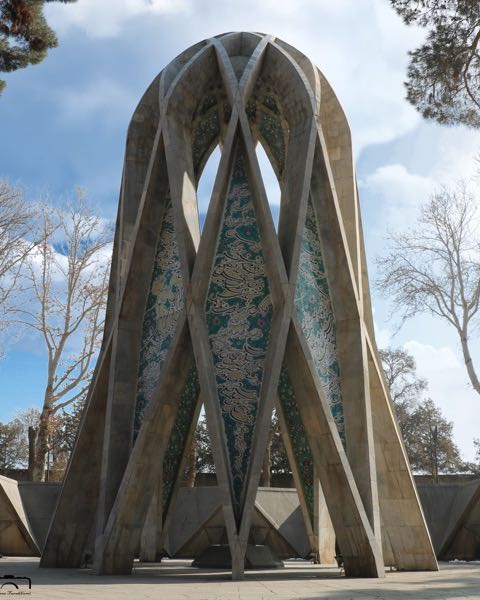
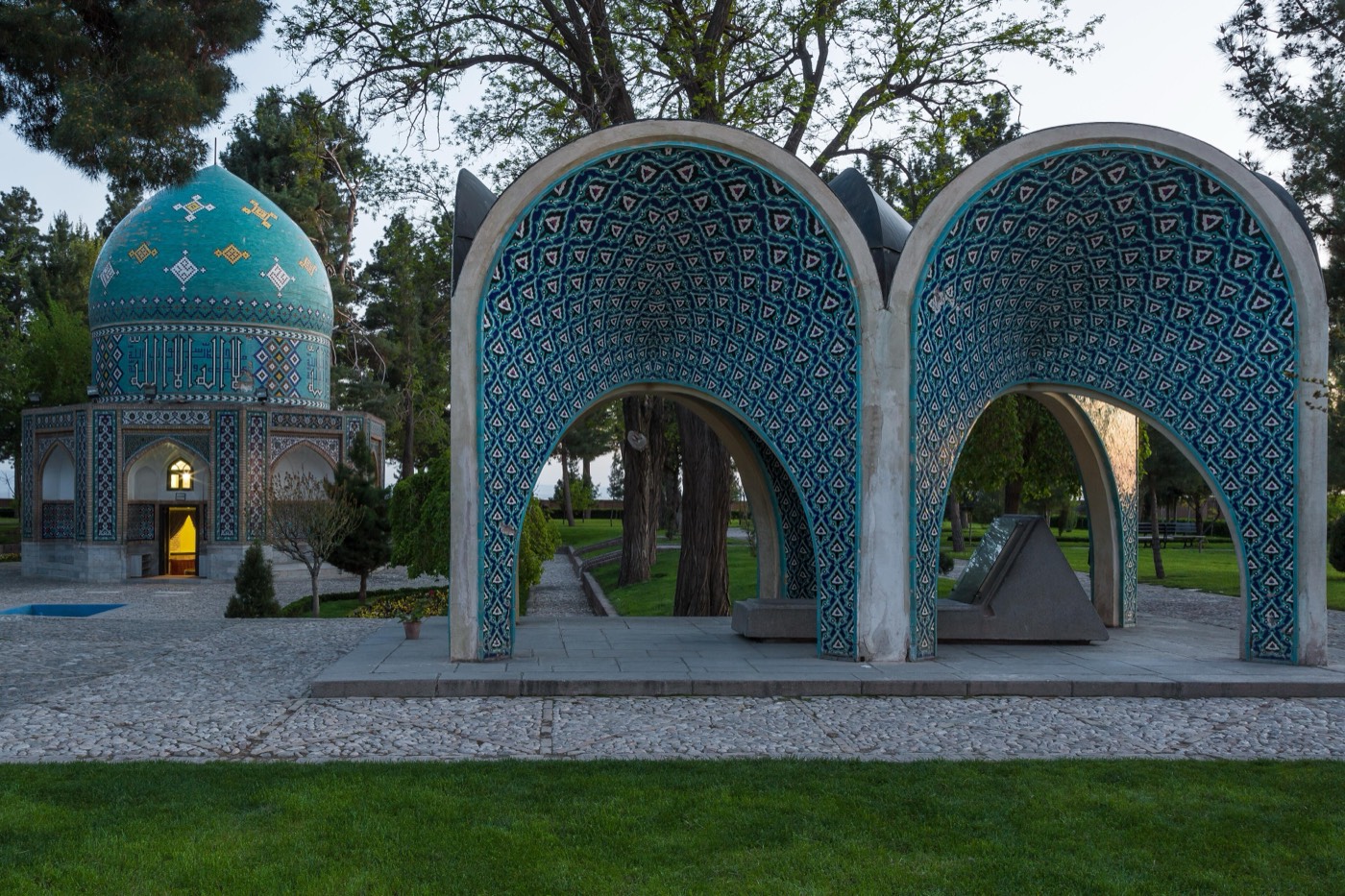
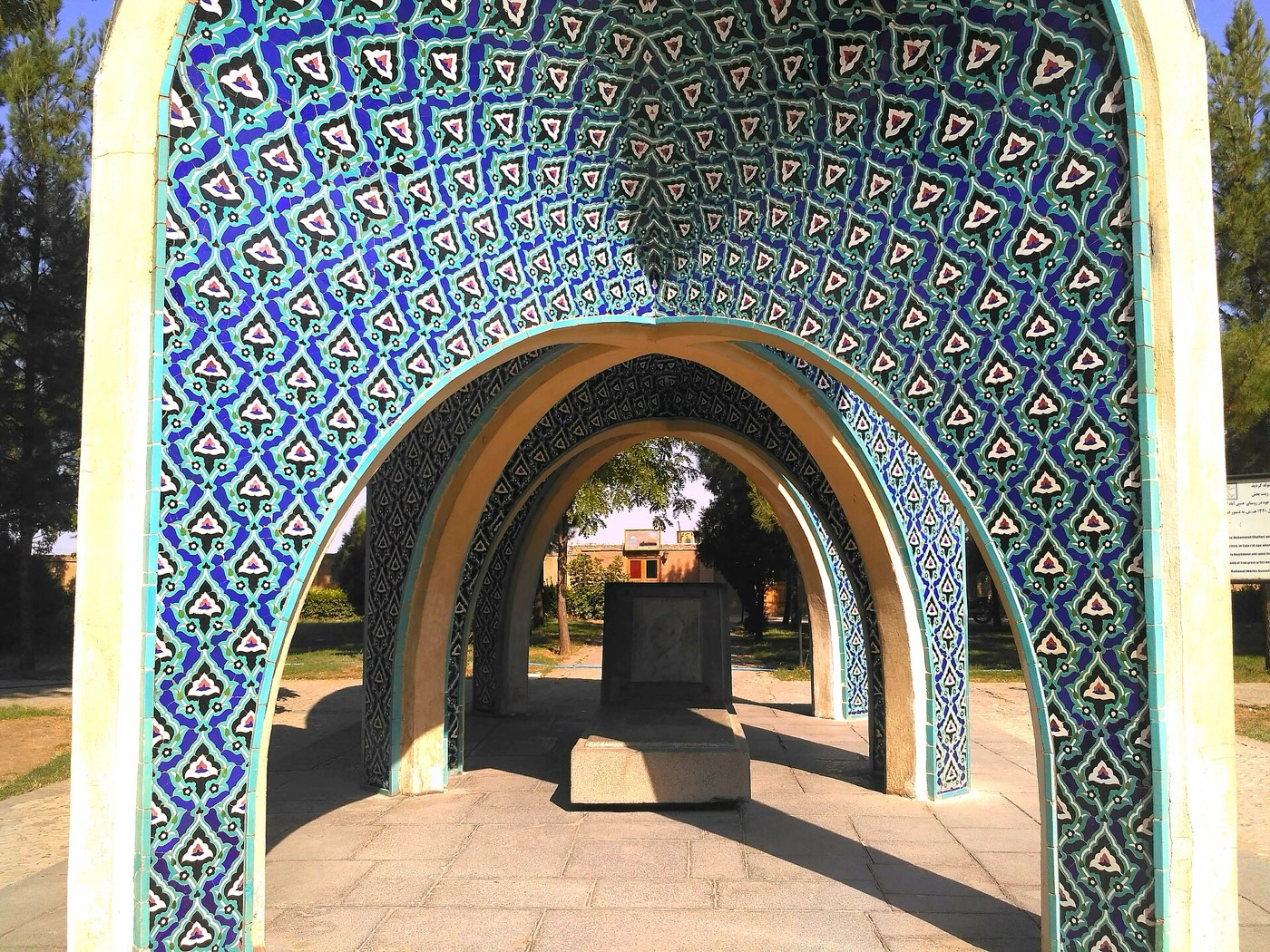
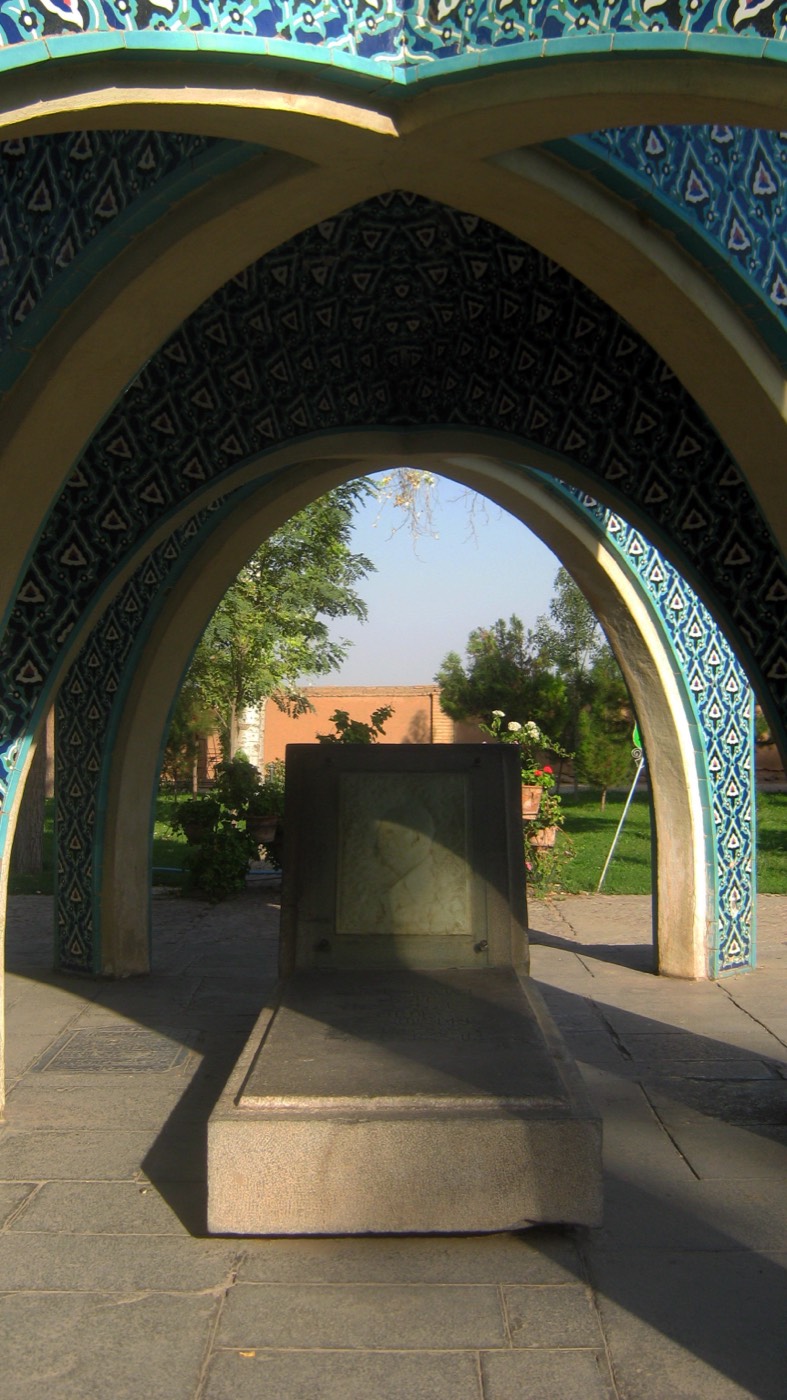
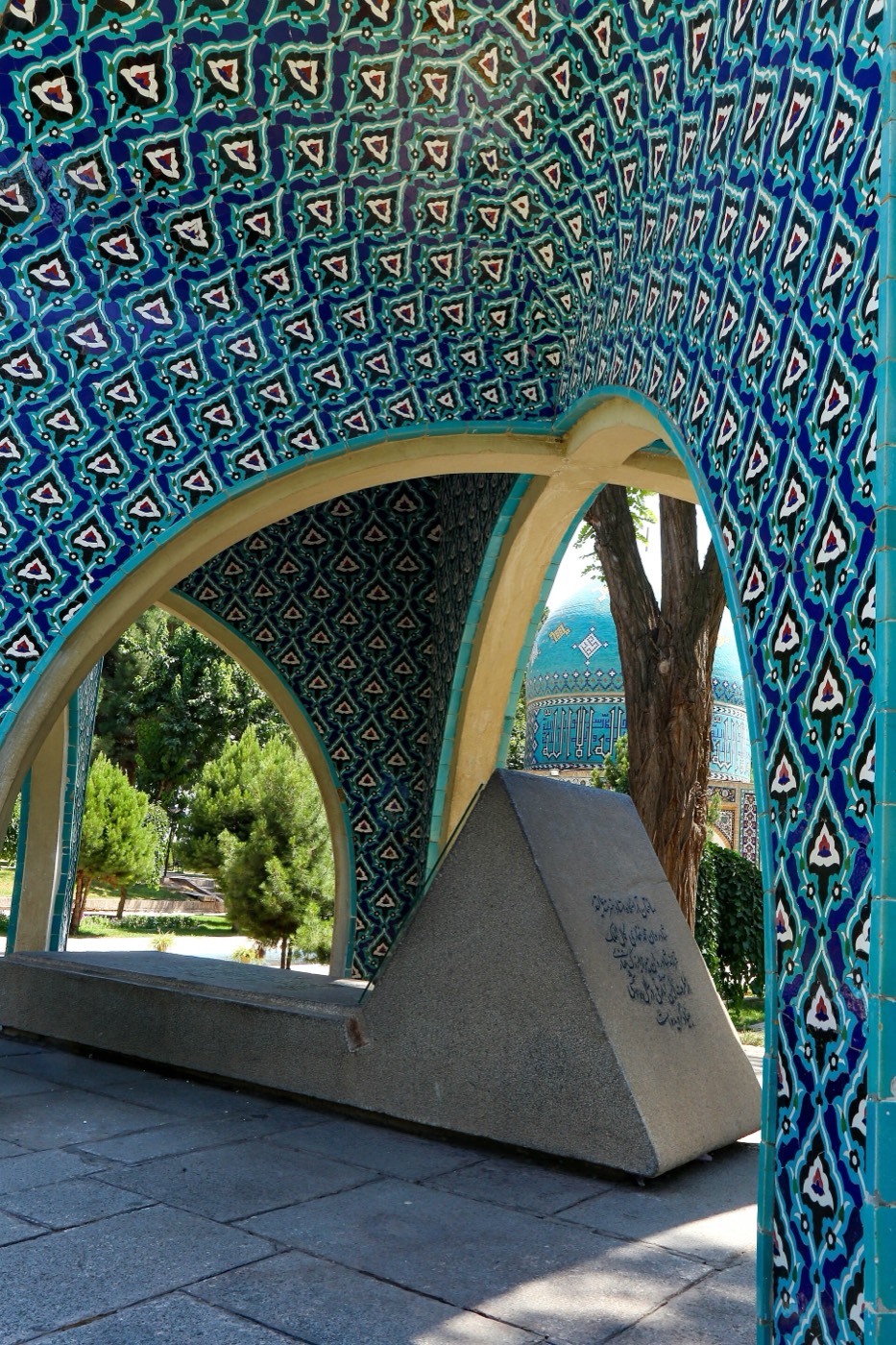
Visit Iran describes the design as a union of traditional and modern architecture in which geometry plays the leading part1,2. The plan is made of two squares in the proportion of one to two2. Each side of the squares carries an arch, so that the four sides of the rectangle are formed by six semicircular arches, and the diagonals of each square form two more arches that cross inside: ten arches in all1,2. Where the arches and their vaults meet above the tomb they form cone-like geometric shapes1,2. The curved surfaces are faced with mosaic tilework in cobalt blue, white and other colours, its motifs growing smaller towards the crown of each arch1,2.
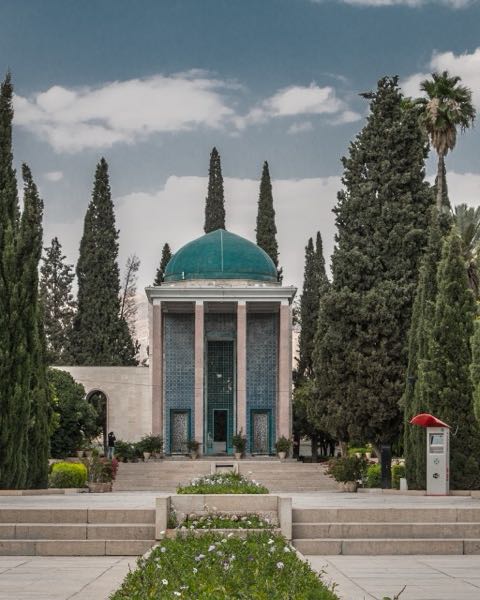
The building is of concrete, stone and tile1,2. It stands in the garden of Attar’s tomb, in the south-east part of the city, and Visit Iran points out how closely its facade, tilework and colours match those of Attar’s tomb next to it1,2,8. According to Archnet, the new tombs of Khayyam and Kamal-ol-Molk were built during the restorations of the 1960s, when Attar’s tomb received its tilework and its surroundings were laid out as a garden8. The same programme joined the gardens of Khayyam, Imamzadeh Mahruq, Attar and Kamal-ol-Molk by a network of avenues, roundabouts and green spaces6.
Inside
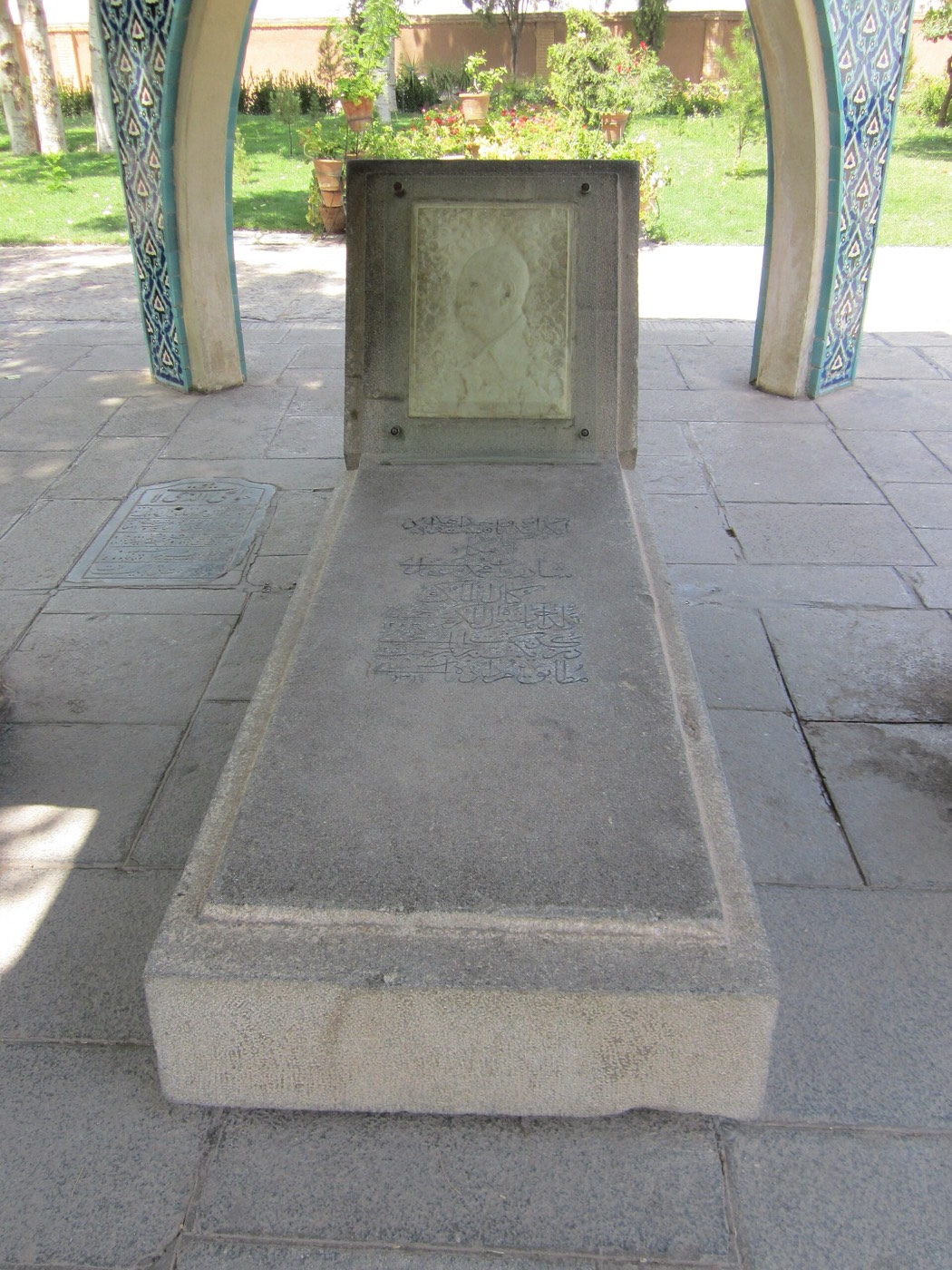
Beneath the crossing arches lies the gravestone, a single block of granite1,2. Its upper end is raised and cut at an angle, and on it one of Kamal-ol-Molk’s pupils carved his portrait in relief1,2. Overhead, the visitor sees the cobalt-blue and white tile mosaic of the curved vaults, its motifs closing in towards the crown of each arch1,2.
What to look for
- Ten arches: six semicircular ones on the sides, and two crossing on the diagonals of each square1,2.
- Mosaic tilework in cobalt blue and white, its motifs shrinking towards the crown of each arch1,2.
- The granite gravestone with a relief portrait of the painter carved by one of his pupils1,2.
- The view across the garden to Attar’s tomb, whose tilework and colours it matches1,2.
Visiting
- The tomb stands in the garden of Attar’s tomb, in the south-east part of Nishapur1,8.
- Omar Khayyam’s tomb is nearby, linked to this garden by an avenue laid out in the 1960s6.
Official information: Iran’s Ministry of Cultural Heritage, Tourism and Handicrafts (official Visit Iran portal)DirectionsOpen in OpenStreetMapGuided tours in Nishapur