History
The tomb stands in the village of Aisha Bibi, formerly Golovachevka, about 18 km from Taraz and some 20 m north of the better-known Aisha Bibi mausoleum2,3,6. Sapatayev and colleagues count the two among the Karakhanid-era mausoleums of Taraz and its surroundings2. A. N. Bernshtam, who surveyed the tomb in 1938-1939, judged it the oldest Karakhanid monument and noted parallels with Armenian architecture of the 11th-12th centuries2,3. In 1939 a member of his expedition, B. N. Dublitsky, suggested that it had begun as a Nestorian church; the authors of a 2025 study see this as a product of Soviet anti-religious policy2.
The name comes from the building itself: a carved terracotta inscription on the main facade calls it the high tomb of Babaji Khatun, and the builder’s name that followed is lost1,3. In the museum-reserve’s legend she was Aisha’s nurse and guarded her grave until her own death; Monique Kervran’s version adds that she was buried in a second mausoleum beside Aisha’s1,5. The tomb came under state supervision in 1947 and was partly restored in 1953 under T. K. Basenov2. Restoration was declared complete in 1982, but a new inscription frieze ordered from the Turkestan workshop was still unfinished in 19852. Soviet campaigns of the 1960s and 1970s tried to stop local pilgrimages to both tombs2.
Architecture
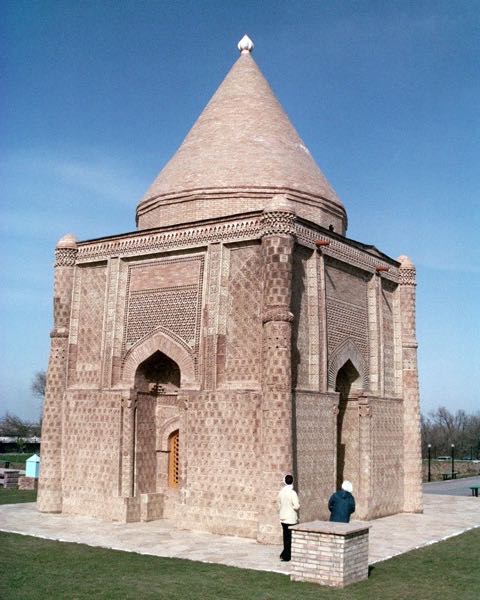
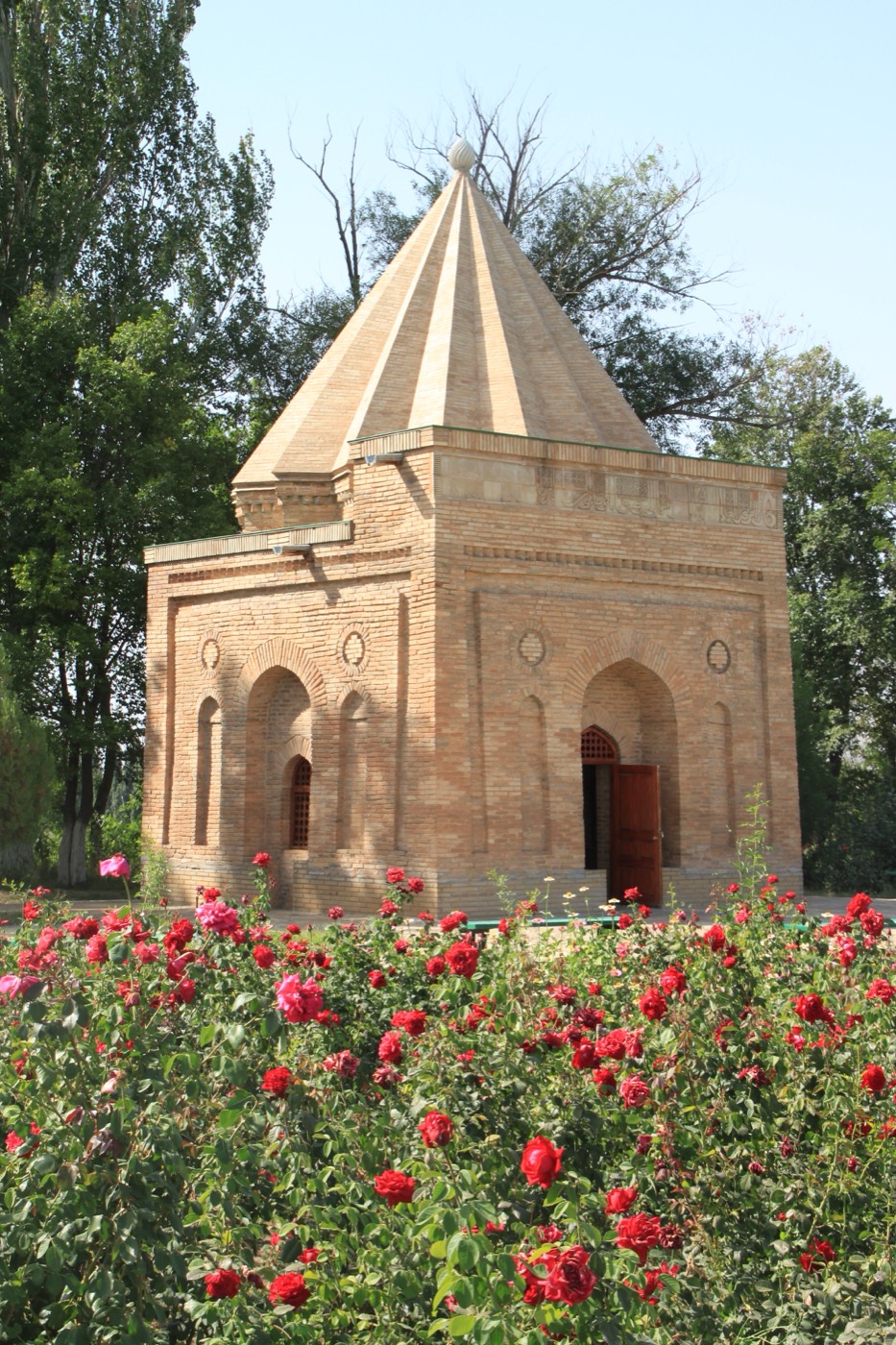
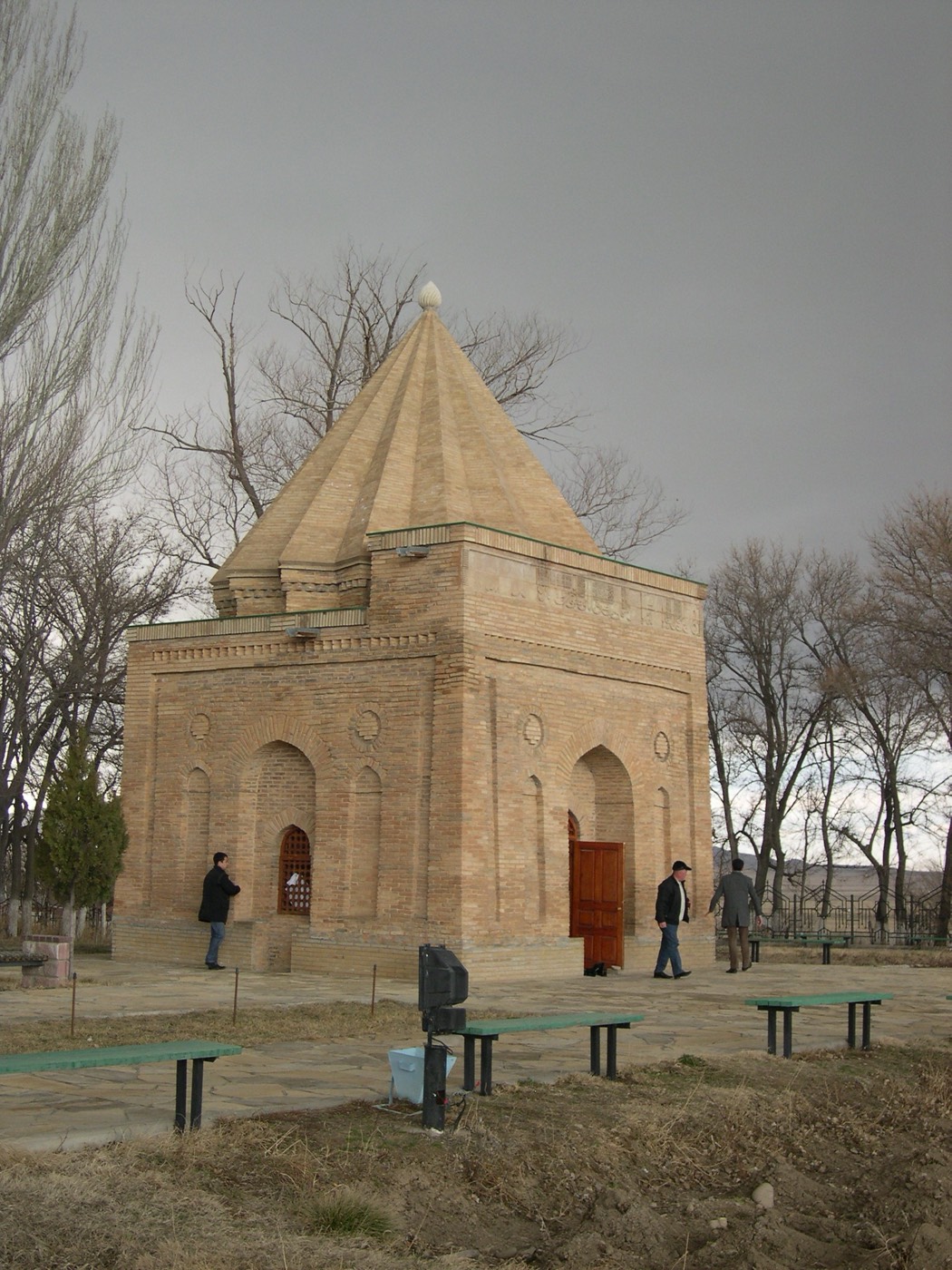
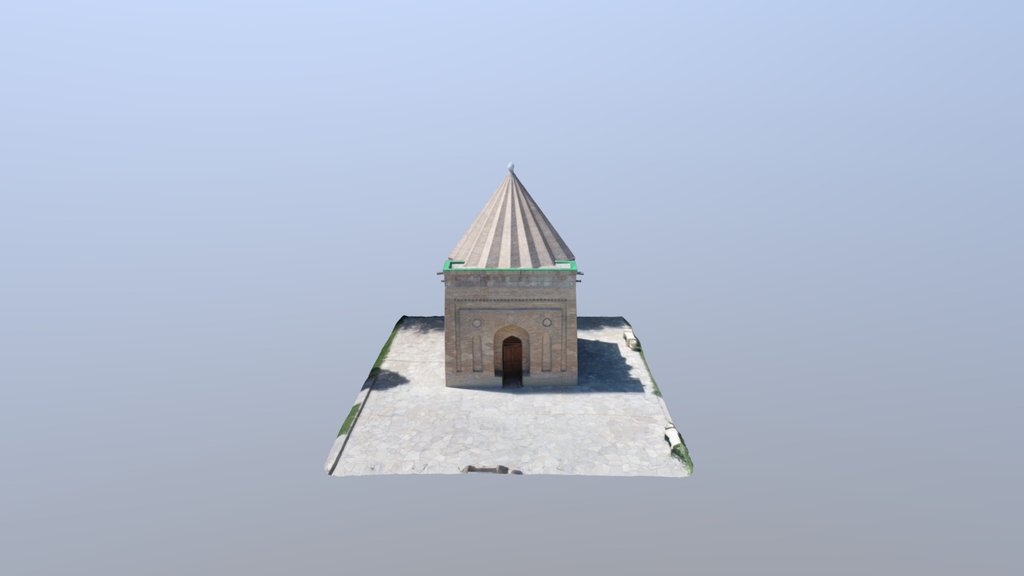
The tomb is a single cube of fired brick without a portal, about 6.8-6.9 m square2,3. Its walls carry no applied ornament; instead, the museum-reserve notes, architectural details are picked out by simple means1. The walls other than the western one share the same scheme, a deep niche reaching the ground between two tall arched windows, and the entrance is on the east3. The main facade is marked by a parapet that carries the inscription frieze in naskh script, and a band of widely spaced bricks in the top courses finishes the facade3. The 2025 study, following Bernshtam, describes a pointed conical dome on an octagonal drum and imitation windows and doors on the walls2.
The museum-reserve calls the sixteen-faceted cone on its prismatic drum a dome unusual for Kazakhstan, and Baitenov and colleagues count the tomb, with its corrugated tent-like dome, among the earliest tent-roofed mausoleums1,4. They group it with Aisha Bibi and the Karakhan mausoleum in Taraz among the first Islamic tombs of southern Kazakhstan, of the 10th-12th centuries, each with its own composition and decoration4. The 2025 study sets the simplicity of Babaji Khatun against the carved terracotta facing of its neighbour2.
Inside
Inside, squinch arches at a height of 1.37 m lead from the square room to an octagonal drum, and from a height of 3.8 m rises the inner dome, a sixteen-sided shell of double-layered curved brickwork; these figures come from Soviet restoration records cited in the 2025 study2.
What to look for
- The sixteen-faceted conical dome on its prismatic drum, a form the museum-reserve calls unusual for Kazakhstan1.
- The fragmentary carved terracotta inscription on the main facade naming the tomb of Babaji Khatun1,3.
- The plain brick walls with deep niches between tall arched windows3.
- The Aisha Bibi mausoleum, about 20 m to the south, faced with carved terracotta2,6.
Visiting
- The tomb stands in the village of Aisha Bibi, Zhambyl District, about 18 km from Taraz3.
- The Aisha Bibi mausoleum stands about 20 m to the south6.
- It was entry no. 104 in Kazakhstan’s 2020 State List of monuments of history and culture of republican significance; that order was repealed by an order of 11 July 20257.
Official information: "Monuments of Ancient Taraz" State Historical and Cultural Museum-Reserve (Ezhelgi Taraz eskertkishteri)DirectionsOpen in OpenStreetMapGuided tours in Near Taraz