History
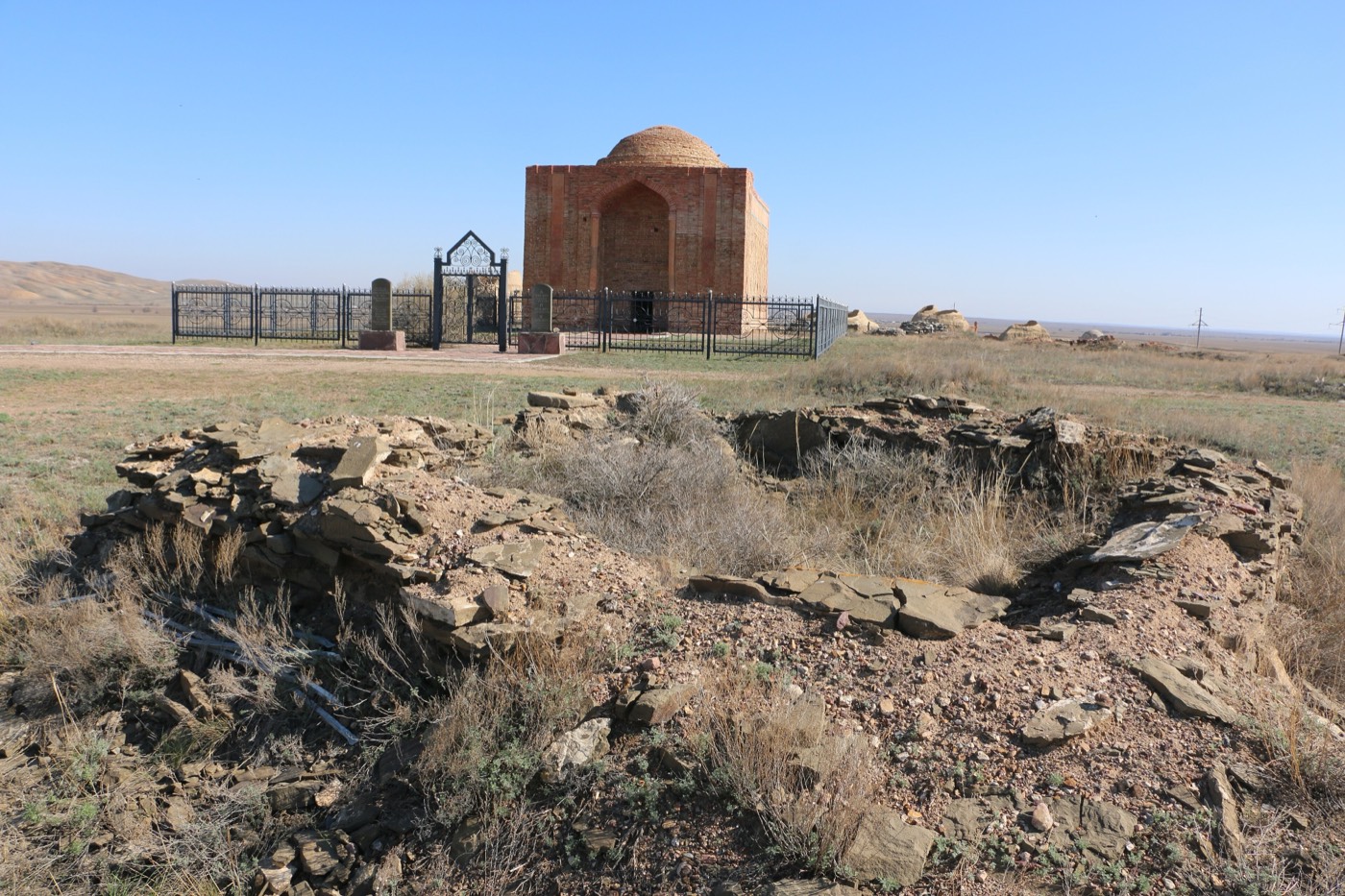
The mausoleum stands 2 km south-west of the village of Malshybai, on the right bank of the Karakengir river in Ulytau District, amid a necropolis of brick and stone tombs and burial mounds1,5. The Kazakh historian and traveller Shokan Ualikhanov listed it in the 1850s among the Kengir tombs he admired3. Early Russian accounts by travellers, topographers and officers describe a brick cube with corner turrets, patterns of white glazed brick and a blue-glazed dome, with an inner passage round the dome reached by a narrow stair in the wall1. The same accounts saw the grave inside covered with horse skulls, strips of cloth and poles hung with horse tails, evidence that the tomb was venerated1.
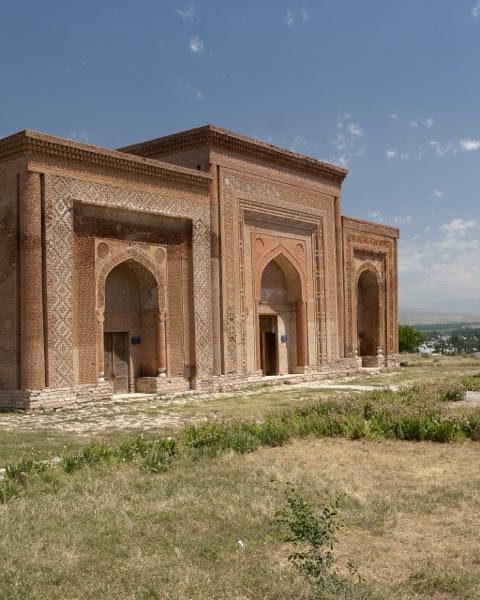
Systematic study began with Alkei Margulan, whose expeditions of 1946-1949 recorded the tombs along the caravan routes of western Saryarka3. He dated the building to the pre-Mongol period, the 10th-11th centuries, by analogy with Karakhanid monuments, and compared it with the Karakhan and Aisha Bibi mausoleums1,3. Kazakhstan’s State List gives the 11th-12th centuries, and Baitenov and colleagues also place it before the Mongol conquest2,5. In Kazakh genealogy Alasha Khan is the ancestor of the tribes called Alty Alash (“the six Alash”), and Margulan read the legends as the memory of a ruler who united the steppe tribes into a first large state1.
Architecture
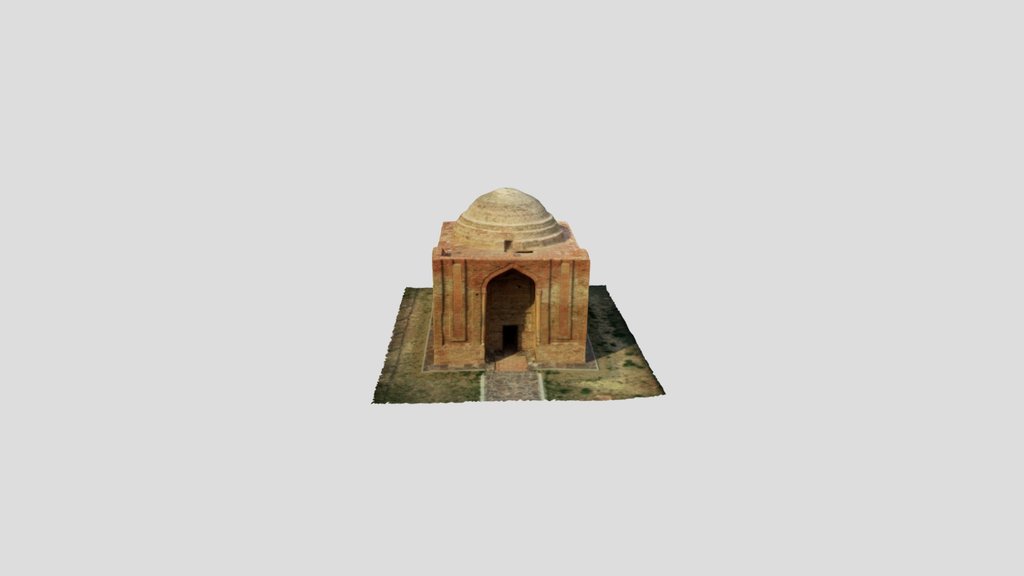
The tomb is a portal-and-dome building of fired brick, 9.8 by 12 m in plan and 10.4 m high to the top of the dome, which is spherical and rests on a sixteen-sided drum1. The main facade, facing south-west, is taken up by a portal with pylons and a deep arched entrance niche; corner columns flank the arch, framed by a U-shaped band of terracotta tiles in a braided geometric pattern1. Between a plinth band and a frieze the walls are laid in patterned brickwork of upright and horizontal bricks1. The frieze is faced with terracotta slabs carved with large eight-pointed stars, edged above and below by narrow strips of turquoise glazed brick and topped by a slightly projecting cornice1.
Baitenov and colleagues find no direct counterpart for the building in Central Asia2. Its octagonal chamber is enclosed in a cubic body, an arrangement they call rare, and they note that it is the only surviving medieval mausoleum in Kazakhstan with a gallery on the upper level1,2. They note its rhomboid brick pattern, which they liken to the lattice frame of a yurt and to the woven “alash” carpets after which, in one version, the tomb is named, and they suggest a possible model in an early medieval building, perhaps a fire temple, at Baba Ata in southern Kazakhstan2. Later Kazakh tombs of Central Kazakhstan took up its octagon-in-a-cube plan, and the Zhuzden (Duzen) mausoleum of 1863-1866 copies it closely2,5.
Inside
Inside, the octagonal chamber has tall niches in the corners and in the middle of each wall, as described by N. I. Krasovsky, and daylight falls through a round opening at the top of the dome1. A stair with high steps in the left corner of the entrance climbs to the gallery on the upper level, and the floor is a single course of brick1.
What to look for
- The upper-level gallery and its steep stair, unique among Kazakhstan’s surviving medieval tombs according to Baitenov and colleagues1,2.
- The octagonal chamber set inside a cubic body, a plan later Kazakh tombs of the region repeated2.
- The frieze of carved terracotta slabs with large eight-pointed stars between strips of turquoise glazed brick1.
- The deep portal niche, its corner columns and the U-shaped band of braided terracotta ornament1.
Visiting
- The mausoleum stands 2 km south-west of Malshybai village, on the right bank of the Karakengir, in Ulytau District; the Jochi Khan mausoleum lies 28 km south-east of the same village5.
- It was entry no. 248 in Kazakhstan’s 2020 State List of monuments of history and culture of republican significance; that order was repealed by an order of 11 July 20255.
- The Ulytau area has been on Kazakhstan’s UNESCO Tentative List since 2021 as the “Cultural Landscape of Ulytau”; the entry does not name individual monuments4.
DirectionsOpen in OpenStreetMapGuided tours in Ulytau District