History
Âşık Paşa was born in Kırşehir in 1272 and died there in 1332, on his way back to Amasya from Egypt3. He was the grandson of Baba İlyas (his father Muhlis Paşa was Baba İlyas's youngest son), and his best-known work is the Garibnâme, a Turkish poem of about 12,000 couplets completed in 13303. TDV describes him as a leading figure of the Vefâiyye order in Anatolia in his time3. He asked to be buried on a hill north-east of Kırşehir3.
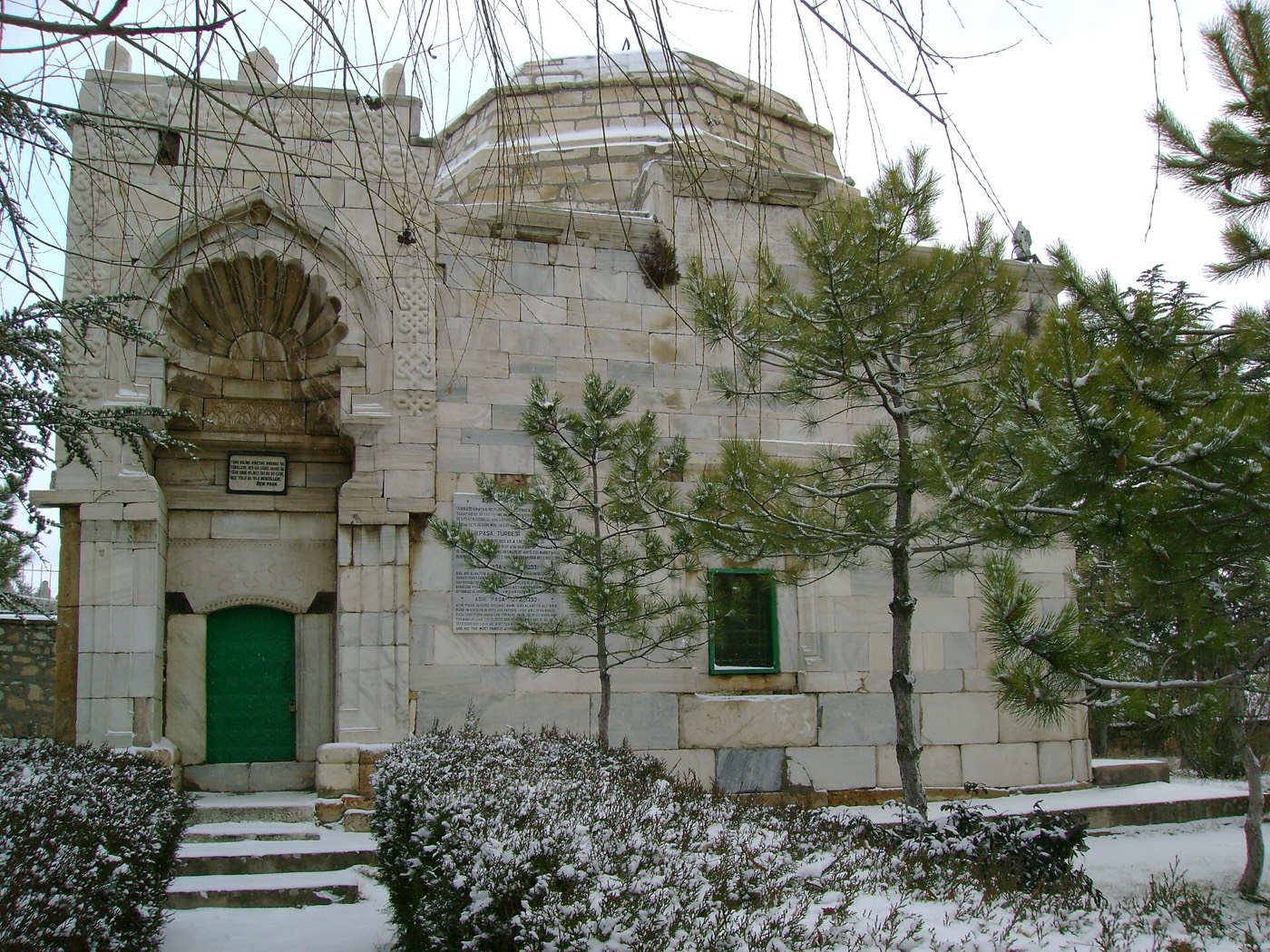
An inscription on the side wall records that the tomb was built for him and that he died on 13 Safer 733 (3 November 1332); it calls him Şeyh Bâce1. The sources do not say who built it, though TDV suggests his nephew Alâeddin Ali Şah, vizier of the Eretnids, as a possibility1. The building and its cemetery were long neglected, and much of the burial ground was damaged; the only documented work is a small repair in 19351. TDV's biography says the public regards the tomb as sacred and visits it, and the Ministry page classes it as faith and cultural tourism2,3.
Architecture
The building is entirely of marble1. An entrance hall, rectangular in plan, is reached through an ornate door, and a side door leads from it to the main chamber, a square about 5.35 m on each side1. The Ministry page describes a single-storey building in two parts, a rectangular entrance and a square domed tomb chamber2. Four columns carry four arches, and pendentives lead up to a blind eight-sided dome built by corbelling1. Saim Ülgen suggested that the dome's shape resembles a Kyrgyz tent1. The Ministry page likewise compares it to a Kyrgyz tent and suggests that the builder may have been a Turk who came with the Khorasan dervishes2. The south front is the most decorated side, with a portal topped by a chain-motif (zincirek) band and a pointed niche1; the Ministry describes the niche as shell-shaped with ten segments and braided ornament, and the portal as one of few examples of Anatolian Seljuk decorative art2.
Inside
What to look for
Visiting
- The tomb stands on a hill within a large cemetery in the Aşık Paşa quarter, on the Ankara-Kayseri road2.
- TDV records family graves nearby, including a stone for Can and one attributed to Hâce Hatun1.
Official information: Republic of Türkiye Ministry of Culture and Tourism (Kültür Portalı, Kırşehir page)DirectionsOpen in OpenStreetMapGuided tours in Kırşehir